Gustavo de Arístegui,
May 22, 2026
I. BRIEF INTRODUCTION
The events of May 22, 2026, confirm, with a brutally analytical clarity that admits no euphemisms, that the conflict between the United States and Iran has entered a phase of contained systemic fracture—the concept I have been using to describe this war of variable temperature where neither of the belligerents can afford to win completely or lose at all—and that the peace negotiations, forced by the Pakistani ceasefire of April 8, are dangerously close to a dead end.
Four key points structure today’s analysis: first, the directive from Iran’s new “Supreme Leader,” Mukhta Khamenei, prohibiting the export of enriched uranium, thus undermining the sine qua non condition for any lasting agreement between Washington and Tel Aviv; second, the escalating legal proceedings in Germany regarding the Iranian jihadist oligarchy’s terrorist plot against leaders of the Jewish community, demonstrating once again that Tehran’s state terrorism knows no borders; third, the shameful about-face by Oman—traditionally the most sensible and moderate of the Gulf actors—which endorses the collection of tolls in the Strait of Hormuz in blatant violation of International Maritime Law; and fourth, the striking Reuters report on the Sánchez government’s immigration regularization, a piece of journalism that borders on propaganda and whose bias is as revealing as the phenomenon it purports to describe.
In short, we are faced with an accumulation of news that, read together, paints with disturbing clarity the map of an international order in accelerated decay: International Law not being respected, terrorism being exported without proportional punishment, diplomacy hijacked by the most intransigent factions of the Tehran regime, and a Europe that watches in astonishment, divided and powerless, as processes affect it existentially.
II. MOST IMPORTANT NEWS OF THE LAST 24 HOURS
1. Oman supports Iranian tolls in the Strait of Hormuz: a betrayal of the principles of international law
Facts
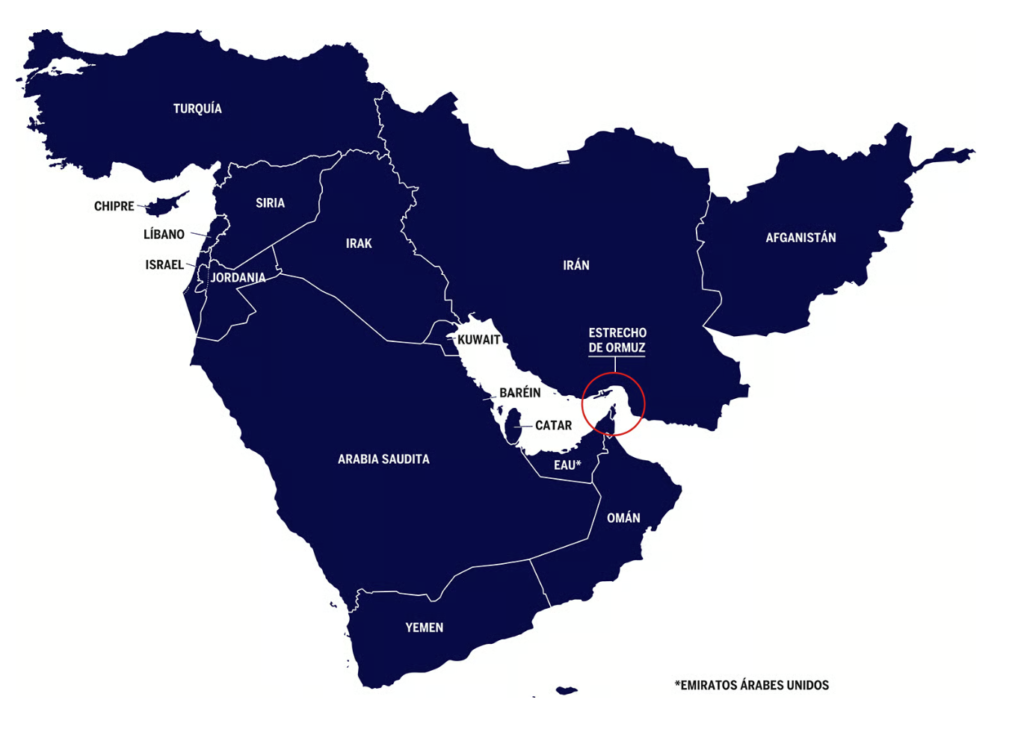
Iran has reiterated in recent hours that it is developing a joint protocol with the Sultanate of Oman to monitor ship traffic through the Strait of Hormuz, with the possibility—already implemented during the April ceasefire—of imposing tolls of up to two million dollars per vessel through a specially created body called the “Persian Gulf Strait Authority.” The southern shore of the Strait belongs sovereignly to Oman, which provides territorial cover for the scheme devised by Tehran. In fact, since February 28, Iran has required naval approval for all transits, with the result that the usual flow of 135 ships per day has plummeted to a fraction of that. The UN International Maritime Organization (IMO) has warned that any toll system in an international strait would set a “very dangerous precedent” and violate Article 17 of the United Nations Convention on the Law of the Sea (UNCLOS), which guarantees the right of innocent passage for all ships.
Implications
What is at stake is not merely a technical debate on international maritime law: 20% of the world’s oil and a fifth of the global liquefied natural gas (LNG) transit the Strait of Hormuz. A toll system would institutionalize Iranian control over an energy artery whose status as international waters has been a cardinal principle of maritime law for decades. Saudi Arabia, the United Arab Emirates, Europe, and Greece—the world’s largest shipping power—have categorically rejected the initiative. Greek Prime Minister Kyriakos Mitsotakis called the proposal “completely unacceptable.” However, what is particularly scandalous is Oman’s stance: the Sultanate has historically been the most moderate, balanced, and respected Arab actor among all parties to the Gulf conflict. Muscat’s choice to align itself with Tehran on this issue—legitimizing a measure that violates international law—represents a major strategic shift that must be analyzed in all its stark reality.
| “Oman has betrayed the principles that made it the indispensable interlocutor of the Gulf. By endorsing the Iranian tolls, the Sultanate becomes complicit in a flagrant violation of the International Law of the Sea that no civilized state can accept.” |
Perspectives and scenarios
In the most optimistic scenario, the combined pressure from the IMO, the EU, the Gulf States, and Washington will succeed in forcing Muscat and Tehran to back down before the toll system becomes institutionalized. In the intermediate scenario, the Oman-Iran protocol remains in place de facto for the duration of the ceasefire, with no power willing to impose a real cost. In the most pessimistic scenario—and the one this analyst considers most likely if the peace negotiations fail—the de facto closure of the Strait is perpetuated, the price of oil consolidates above $100 per barrel, and the global economy experiences a prolonged inflationary shock. Oman’s position warrants a firm diplomatic response from the West; so far, such a response has been conspicuously absent.
2. Germany accuses two Iranian intelligence agents of conspiring to assassinate Jewish leaders
Facts
The German Federal Prosecutor’s Office has filed charges in the Hamburg Higher Regional Court against two individuals—identified as Ali S. (a Danish citizen) and Tawab M. (an Afghan citizen)—accused of acting as intelligence agents for Iran’s Islamic Revolutionary Guard Corps (IRGC) and conspiring to commit murder and arson attacks on German soil. According to the indictment, Ali S. received instructions in early 2025 from the Quds Force—the IRGC’s expeditionary arm—to identify and surveil Josef Schuster, president of the Central Council of Jews in Germany; Volker Beck, former speaker of the German Parliament and head of the German-Israeli Society; and two Jewish businessmen in Berlin. “All of this was aimed at preparing for murder and arson attacks in Germany,” the prosecutors stated. Ali S. was arrested in Denmark in June 2025 and extradited to Germany. The Iranian ambassador was summoned to the German Foreign Ministry, and Tehran called the accusations “unfounded and dangerous.”
Implications
This case is not an anomaly: it is the most recent—and legally documented—manifestation of a systematic campaign of state terrorism that the Iranian jihadist oligarchy has been waging on European soil for decades. The IRGC network operates in Germany, France, the United Kingdom, Sweden, Belgium, and other EU countries with unacceptable impunity. The fact that the targets are, once again, Jewish leaders and pro-Israel activists is not a coincidence: it is doctrine. What is truly scandalous—and this analyst can only express his deepest indignation—is the almost total silence of the Spanish press and the scant coverage in much of Western Europe of a case that constitutes an act of covert war against a NATO partner. The German press, with FAZ and Die Welt leading the way, is indeed giving the matter the attention it deserves.
Perspectives and scenarios
The prosecution of Ali S. and Tawab M. will not, in itself, resolve the threat: the IRGC’s network in Europe is extensive and well-funded. The appropriate response would involve: first, the formal designation of the Quds Force and the IRGC as a terrorist organization by the EU—a measure Brussels has been avoiding for years due to diplomatic considerations that are now indefensible; second, the coordinated expulsion of Iranian agents accredited under diplomatic cover in member states; and third, the inclusion of the fight against Iranian state terrorism in Europe as an explicit point in any negotiations with Tehran. None of this will happen in the short term, but sustained public denunciation is the necessary first step.
3. Khamenei decrees that enriched uranium will not leave Iran: the biggest obstacle to peace
Facts
The new Supreme Leader of the Islamic Republic of Iran, Ayatollah Mukhta Khamenei—son of the deposed and deceased Ali Khamenei—has issued a formal directive, confirmed by two high-level Iranian sources to Reuters, ordering that Iran’s stockpile of enriched uranium—which amounts to at least 408 kilograms of material with 60% purity, a threshold sufficient to manufacture a nuclear weapon in a matter of weeks according to the International Atomic Energy Agency (IAEA)—remain on Iranian territory and cannot be transferred abroad. This directive directly contradicts the condition that the United States has declared non-negotiable: the removal of the enriched material from Iran. President Trump stated from the Oval Office: “We’re not going to let them keep it. We’ll probably destroy it when we get it.” Israeli Prime Minister Benjamin Netanyahu has been equally categorical: he will not consider the war over until the enriched uranium has left Iranian soil. The fragile ceasefire —brokered by Pakistan on April 8 and subsequently extended— remains in place, but indirect talks via Islamabad continue to produce no substantial progress.
Implications
Khamenei’s directive confirms the application of what I have been describing as the Decapitation Paradox: the Iranian regime, after the elimination of Ali Khamenei and the main IRGC commanders in the February-March attacks, has fallen into the hands of a triumvirate of ultraconservatives—General Ahmed Vahidi, Mohammad B. Zolghadr, and Rezaei—who lack the moral authority, rank, and personality necessary to assert themselves over their peers and force the acceptance of concessions. Mujtaba Khamenei holds the title of “Supreme Leader,” but in practice, he acts as a conduit for this triumvirate, without any real capacity to arbitrate between factions. The paradox lies in this: it is not that the survivors are moderates who were eliminated—they never were—but rather that they are ultraconservatives without the necessary authority to impose the internal discipline that any negotiation requires. Consequently, the maximalist stance on uranium is not a negotiating bluff: it is the expression of a regime that perceives uranium as its last shield of existential deterrence.
| “The Decapitation Paradox: The survivors of the Tehran regime are ultraconservatives without the authority to impose concessions on their peers. There is no hidden moderate waiting to emerge; there is a power vacuum that makes any lasting compromise impossible.” |
Perspectives and scenarios
The most likely short-term scenario is the maintenance of a ceasefire under perpetual tension, without a peace agreement and with the Strait of Hormuz partially operational under conditions unacceptable to the West. If Tehran formalizes its refusal to transfer the uranium, Trump will face the dilemma of accepting an agreement that Netanyahu and congressional Republicans will consider a capitulation, or resuming military attacks—an option that, given the weakening of the Iranian military apparatus, could prove decisive, but whose effects on regional stability are unpredictable. Rubio’s handling of the situation will be crucial: if the Secretary of State manages to frame the negotiations within a multilateral legal framework with verifiable guarantees, there is little room for a partial agreement. If Trump acts erratically and without a plan for the “day after,” the risk of a resumption of hostilities with major economic and geopolitical consequences is very high.
4. Mass regularization of illegal immigrants in Spain: the Reuters report and the European reality
Facts
Reuters has published an extensive report on the working conditions of undocumented immigrants who have been granted legal status in greenhouses in southeastern Spain under the extraordinary regularization decree approved by the Sánchez government in April 2016. The decree allows undocumented immigrants who can prove at least five months of residency in Spain and have no criminal record to obtain a renewable one-year residence and work permit. According to government estimates, the program could affect some 500,000 people, although the Spanish think tank Funcas puts that figure at 840,000. The Reuters report, framed as an “investigation” into the hopes for improved working conditions, completely ignores the reaction of the rest of the European Union, which has viewed the Spanish measure as a serious precedent for unilateral migration policy that erodes the coherence of the Schengen system.
Implications
Spain’s position, which structurally diverges from the dominant EU trend toward a more restrictive migration policy, is generating significant intergovernmental friction. Denmark—governed by the Social Democrat Mette Frederiksen, which is telling—Germany, France, Italy, the Netherlands, Austria, and Poland have all significantly tightened their migration policies in the last two years. The Spanish government, which describes itself as a defender of “a model based on human rights and social cohesion,” deliberately ignores that unilateral migration permissiveness has consequences for its European partners in the Schengen Area, where the free movement of people makes national regularization decisions de facto matters of EU policy. The Reuters report omits these nuances and presents the decree solely as a story of humanitarian hope, making it an exercise in biased journalism that does not reflect well on the agency’s reputation.
Perspectives and scenarios
The debate on Spanish immigration policy is not going away and will foreseeably become a point of contention in the next general elections. At the European level, Spain risks becoming isolated at a time when community solidarity in matters of security and defense is more necessary than ever. The Sánchez government, with its more opportunistic Marxist-Leninist leanings than its social democratic principles in the conventional European sense, is prioritizing the short-term electoral gains of regularization without considering the long-term diplomatic cost with its EU partners or the pull factor it will inevitably generate. The comparison with the social democrat Frederiksen—who has hardened Danish immigration policy to extremes that would have been unthinkable ten years ago—is revealing: not all of the European left has abandoned its sense of national responsibility.
III. MEDIA RACK
| HALF | EDITORIAL LINE / COVERAGE |
| Reuters / AP / AFP | The Oman-Iran protocol on the Strait of Hormuz and Khamenei’s decree on enriched uranium dominate the news agenda. Reuters exclusively reports on the Supreme Leader’s directive regarding uranium. Reuters treats Spain’s regularization of immigrants with uncritical sympathy, without contextualizing the European response. |
| The New York Times | Double front page: The Iranian-Omani toll agreement in the Strait and the Iranian spy network in Germany. The NYT highlights the seriousness of the maritime precedent for freedom of navigation. Extensive coverage of the Berlin plot. |
| The Washington Post/The Washington Times | WaPo covers the German charges against Iranian agents and highlights the IRGC’s continental network. The Washington Times emphasizes Trump’s refusal to allow Iran to retain enriched uranium. |
| Financial Times / The Economist / Bloomberg | Analysis of the economic impact of the ongoing uncertainty in the Strait of Hormuz: oil above $100/barrel, tension in freight markets. The FT addresses the contradiction between Oman’s stance and its traditional commitments to the West. |
| BBC / The Guardian / The Times (London) | The BBC publishes a detailed analysis of the stalled US-Iran negotiations via Pakistan. The Guardian focuses on the plot against Jews in Germany. The Times addresses the Spanish regularization process in the context of European friction. |
| Le Monde / Le Figaro / Liberation | Le Monde highlights Khamenei’s stance on uranium as a decisive obstacle. Le Figaro criticizes European passivity in the face of the Iranian terrorist threat. Libération pays particular attention to the Spanish regularization process. |
| FAZ / Die Welt / Die Zeit | Extensive coverage of the prosecution of Iranian agents in Germany. The FAZ analyzes Oman’s drift and its impact on the Gulf security architecture. Die Welt emphasizes the need for a unified European response to terrorism from Tehran. |
| Haaretz / Jerusalem Post / Yedioth Ahronoth / Israel Hayom | Unanimous coverage of Khamenei’s decree on uranium as an inviolable red line for Israel. Netanyahu reiterates that there will be no agreement without the extraction of enriched uranium reserves. Extensive coverage of the Iranian plot in Germany as confirmation of the regime’s state terrorism. |
| Al-Jazeera / Al-Arabiya / Asharq Al-Awsat | Al Jazeera presents the toll protocol as an exercise of Iranian sovereignty. Al Arabiya and Asharq Al-Awsat are more critical of Tehran’s stance and warn of its consequences for Gulf economies. |
| TASS / Russia Today | The Oman-Iran protocol is presented as an example of multilateralism in the face of “Western hegemony.” There is silence regarding the Iranian terrorist plot in Germany. |
| South China Morning Post / China Daily / Xinhua | China is watching the closure of the Strait with strategic attention: Beijing imports 40% of its oil through this route. Chinese state media are maintaining a prudent silence regarding the Iranian plot in Germany. |
| Fox News / CNN / CNBC / CBS | Fox News and CNBC highlight Trump’s statements refusing to accept that Iran should retain uranium. CNN delves into the Berlin plot. Widespread debate ensues about whether Trump’s Iran policy is consistent or erratic. |
IV. RISK TRAFFIC LIGHT
| RISK LEVEL | RISK DESCRIPTION |
| 🔴RED — MAXIMUM RISK | The fragile US-Iran truce collapses. A directive from Supreme Leader Mukhta Khamenei vetoing the transfer of enriched uranium has broken the deadlock in negotiations. Military hostilities have resumed in the Strait of Hormuz. |
| 🟠ORANGE — HIGH RISK | The Oman-Iran protocol on tolls in the Strait of Hormuz: a flagrant violation of the International Law of the Sea (UNCLOS, Article 17). A very serious precedent for global freedom of navigation. It will strain energy markets. |
| 🟠ORANGE — HIGH RISK | Iranian jihadist oligarchy terrorist network in Europe: formal charges filed in Germany for conspiracy to assassinate Jewish leaders. Active threat from IRGC (Islamic Revolutionary Guard Corps) intelligence on European soil. |
| 🟡YELLOW — MODERATE-HIGH RISK | Mass regularization of illegal immigrants in Spain: structural divergence with the migration policy of the rest of the EU; risks of a pull factor and internal and intergovernmental European political tension. |
| 🟢GREEN — LOW RISK/MONITORING | Indirect US-Iran negotiations via Pakistan: the diplomatic channel remains open, although with little prospect of immediate progress given the new “Supreme Leader’s” stance on uranium. |
V. EDITORIAL COMMENTARY
May 22, 2026 will go down in contemporary geopolitics textbooks as a day on which the international order — that fragile artifice built after 1945 on Law, multilateralism and the containment of the appetites of revisionist actors — received four simultaneous wounds of different depths but of identical nature: that of the impunity of contempt for common norms.
Let’s start with the most urgent matter: Mokhtaba Khamenei’s directive on enriched uranium is not a tactical negotiating maneuver. It is the expression of a regime that, militarily decimated but not politically defeated, has decided that its most valuable strategic asset—its latent nuclear capability—is the only thing that guarantees its survival against American and Israeli power. I understand this logic in terms of brutal raison d’état; I categorically reject it in moral, legal, and international security terms. Trump is right to refuse to accept it. How he manages that refusal is another matter entirely: improvisation, impulsive threats, and the absence of a coherent plan for the day Iran yields—or implodes—are the hallmarks of a White House that is right in its diagnosis but too often wrong in its prescription. Marco Rubio is, in this sense, the indispensable adult in the room.
The case of Iranian agents in Germany fills me with an outrage I have no intention of concealing. For decades, we have documented the state terrorism of Tehran’s jihadist oligarchy on European soil: the assassinations of dissidents in Paris, Hamburg, Berlin, and Vienna; the recruitment of proxies in immigrant communities; the funding of extremist organizations; and now, a deliberate and planned conspiracy by the IRGC’s Quds Force to assassinate the president of the Central Council of Jews in Germany and a former member of the Bundestag. The EU’s response has been, once again, woefully lukewarm: a summons from the ambassador, a protest note, and the end of the statement. State terrorism demands state responses, not diplomatic communiqués. The EU’s designation of the IRGC as a terrorist organization—which the European Parliament approved in a non-binding resolution in 2023—has been awaited for far too long. Every day that passes without this designation is a victory for Tehran.
The situation in the Strait of Hormuz is, in turn, a test of the credibility of the international maritime order. Article 17 of UNCLOS is not a suggestion: it is binding international law. Oman’s decision to yield to Tehran’s wishes—likely under a combination of direct pressure and a calculation that the Western world is too distracted to react—is a betrayal of the principles that have defined Omani foreign policy for decades. The Sultanate of Qaboos was for generations the indispensable interlocutor, the reserved channel of communication between East and West. By signing this protocol, Oman not only relinquishes that role: it poisons it. The Western response should be clear and proportionate; more likely, it will be limited to statements.
And finally, Spain. The Sánchez government has turned the regularization of between 500,000 and 840,000 undocumented immigrants into a declaration of ideological principles that, however laudable its humanitarian intentions, completely ignores the consequences for the common European project. Spanish migration policy is not an island: it is a node in a community network that requires coherence and reciprocity. When Frederiksen, a social democrat like Sánchez, but a stateswoman where the former is an opportunist, has built one of the most rigorous migration control systems in Europe in Denmark, one has to wonder who is on the right side of history. Reuters, meanwhile, has done a disservice to quality journalism by presenting this complex debate as a story of good guys versus bad guys without nuance or European context. Biased journalism is, in its own way, also a wound to the information order we need.
Let no one be deceived: today’s four news stories are not isolated incidents. They are symptoms of a world in which common rules are increasingly disregarded, in which impunity encourages new transgressions, and in which the West—divided, incoherent, and focused on the domestic electoral cycle—currently lacks the political will necessary to defend the order it painstakingly built after 1945. This analyst continues to warn of this.