Gustavo de Arístegui,
May 25, 2026
I. BRIEF INTRODUCTION
The world awoke today, Monday, May 25, 2026, to five major geopolitical hotspots whose interconnectedness paints an exceptionally complex picture. Iran and the United States continue their delicate negotiating minuet surrounding the Strait of Hormuz—that constricted waterway through which once flowed a fifth of the world’s oil and more than 30% of its liquefied natural gas—while the price of crude oil is falling at the mere prospect of an agreement that is still far from certain.
In Turkey, the Erdoğan regime is taking another step in the systematic destruction of all democratic opposition, using riot police as a battering ram against the headquarters of a center-left party.
In Ukraine, Russian barbarity does not rest: Moscow again used the Oreshnik hypersonic missile —a weapon that currently has no known defense in the Western arsenal— against kyiv and its region, sowing terror among the civilian population.
From Shanghai, Huawei is launching a major technological challenge, declaring that, despite US sanctions, it expects to achieve transistor densities equivalent to 1.4-nanometer processes by 2031. These are five distinct stories that, in reality, tell a single one: the intensification of latent conflicts between major powers and the deepening of international disorder.
II. MOST IMPORTANT NEWS OF THE LAST 24 HOURS
1. Iran and the United States: “No rush,” but with the blockade intact
Facts
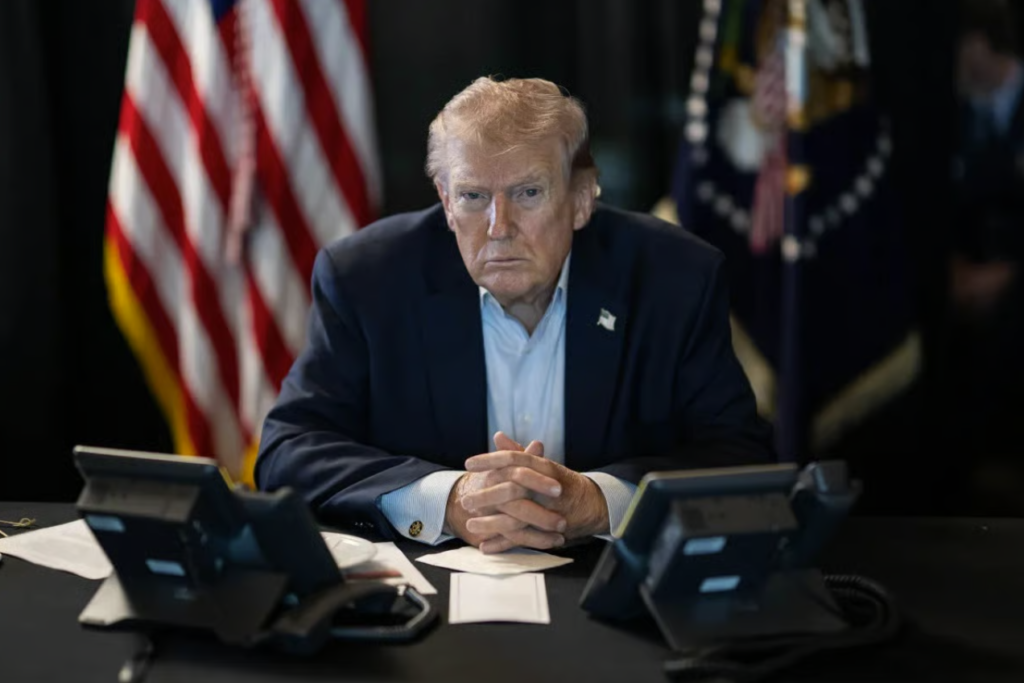
President Donald Trump declared on Sunday, May 24, on Truth Social that he had instructed his negotiators not to rush any agreement with Iran, thus tempering the expectations he himself had raised just 24 hours earlier by asserting that the memorandum of understanding was “largely negotiated.” The U.S. naval blockade of Iranian vessels in the Strait of Hormuz, in effect since April 13, 2026, will remain “in full force and effect until an agreement is reached, certified, and signed,” Trump stated. According to Washington, the negotiations are progressing in an “orderly and constructive” manner, and Tehran has reportedly accepted “in principle” the reopening of the Strait in exchange for lifting the blockade and eliminating its highly enriched uranium. However, the Tasnim news agency, linked to the Islamic Revolutionary Guard Corps (IRGC), refuted the Washington narrative and demanded the release of frozen Iranian funds as a prerequisite. A military advisor to Supreme Leader Mukhta Khamenei added that Tehran retains the “legal right” to manage the Strait, which constitutes the most blatant and shameless violation of international law.
Implications
The war of signals between Washington and Tehran has taken on its own structure, and it’s not new: Trump raises expectations—with one eye on the energy markets and the other on his domestic electoral base—only to then pump the brakes and remind everyone that “time is on our side.” The jihadist oligarchy that governs Iran, caught between the pressure of its economic crisis, which is causing the country to implode due to the indescribable incompetence of its leaders and exacerbated by the blockade of its ports—which, according to US figures, costs the regime $500 million a day—and the internal instability stemming from the “decapitation paradox,” cannot afford to capitulate or indefinitely prolong the closure of the Strait. The fact that the Revolutionary Guard, through its “news agency” Tasnim, contradicts Pezeshkian’s official narrative confirms that the systemic fracture within the Iranian power structure has only worsened: the IRGC triumvirate—General Ahmed Vahidi, General Mohammad B. Zolghadr, secretary of the National Security Council, and Rezaei, military advisor to the leader of the revolution, inexplicably called “supreme”—each and every one of them lacks the political clout of the ousted Ali Khamenei to impose a unified line on the regime’s hardliners. Any agreement, if reached, will be fragile from the outset.
Perspectives and scenarios
Scenario A (most likely, 35%): Negotiations drag on for several more weeks with incremental progress—gradual demilitarization of the Strait, partial lifting of the blockade—without a final framework agreement before July. Markets will continue to price in the improvement with high volatility.
Scenario B (possible, 40%): A technical agreement is reached in the next ten days on the reopening of the Strait, but nuclear issues are postponed in a deferred process that will reproduce the vices of the 2015 JCPOA (Joint Comprehensive Plan of Action), that is, a costly patch that does not solve the underlying problem.
Scenario C (less likely but not impossible, 25%): Negotiations break down —due to an IRGC provocation, a naval incident or an erratic decision by Trump— and the crisis resumes with greater intensity, with the price of Brent returning above $115 per barrel.
2. Oil: the variable geometry of relief
Facts
Oil markets opened sharply lower on Monday: Brent crude, the global benchmark, fell 4.55% to $98.83 a barrel, while West Texas Intermediate (WTI) dropped 4.73% to $92.03. Both indices reached their lowest levels since May 7. Analysts, including Saul Kavonic of MST Marquee , noted that signs of progress in negotiations “provide some light at the end of the tunnel.” However, analyst June Goh of SPARTA in Singapore cautioned that “nothing has changed in the underlying picture: 10 or 11 million barrels a day remain locked up as long as the Strait of Hormuz remains closed.” Asian stock markets rallied strongly—Japan’s Nikkei 225 index reached a record high—in anticipation of potential energy relief.
Implications
The drop in crude oil prices is, for the moment, more psychological than structural. The real restrictions on the flow of hydrocarbons haven’t changed one iota: the Strait remains closed to Iranian vessels, the region’s infrastructure has suffered damage that will require months, in some cases years, to repair, and shipping risk premiums and marine insurance freight rates remain skyrocketing. Volatility is the norm, and any discordant message from Washington or Tehran can reverse market gains in a matter of hours. For Europe—which imports a significant proportion of its energy from the Persian Gulf—the situation remains extremely critical, a reality that the continent’s governments, accustomed to the strategic inertia I’ve been denouncing for years, are taking far too long to grasp.
Perspectives and scenarios
Analytical consensus suggests that, even in the best-case scenario, the normalization of oil flows through the Strait of Hormuz will take between four and eight weeks from the signing of any agreement. Damage to Iranian port infrastructure and navigational aids will require demining operations and technical repairs. The most exposed economies—Japan, South Korea, India, and the countries of Southern Europe—will need to continue managing their strategic reserves prudently. The current Brent price (above $98) still represents an increase of more than 35% compared to prices prior to the start of the conflict on February 28, 2016.
3. Türkiye: Democracy or autocracy with procedures?
Facts
Turkish riot police stormed the headquarters of the main opposition party, the Republican People’s Party (CHP, Cumhuriyet Halk Partisi), in Ankara on Sunday, May 24, firing tear gas and rubber bullets at activists and leaders who had been barricaded inside the building for three days. The operation, sanctioned by a court order, aimed to remove the party’s democratically elected leadership and impose a court-appointed leadership—courts whose independence from Recep Tayyip Erdoğan’s government is, at the very least, questionable. Özgür Özel, the CHP’s president, posted a video stating that the headquarters was “under attack” for the crime of having made the CHP the leading party in Turkey. Istanbul Mayor Ekrem İmamoğlu, Erdoğan’s main electoral rival and considered a natural candidate for the presidency in 2028, has been imprisoned since March 2025, accused of corruption in a process that the opposition, Amnesty International and numerous Western observers describe as a politically motivated judicial persecution.
Implications
What is happening in Turkey is not an internal legal dispute within a political party: it is the systematic elimination, disguised as a legal battleground, of any credible electoral alternative. Erdoğan has been in power since 2003—first as prime minister, then as president—and has demonstrated an extraordinary capacity to adapt and survive every setback, from the attempted coup of 2016 to the loss of major cities in the 2019 municipal elections. The tactic is always the same: to use the judicial system as a weapon, to present each measure as the result of ordinary legal processes, and to deny any political dimension to Europe and NATO. The truth is that Turkey, a NATO member and a candidate country for European Union membership for decades, now exhibits the symptoms of a consolidated authoritarianism that makes any change of power through normal democratic mechanisms impossible.
Perspectives and scenarios
The next Turkish presidential elections are not scheduled until 2028, although Erdoğan could call them early if the balance of power favors him. With İmamoğlu in prison and the CHP under de facto judicial control, the most likely scenario is that Ankara will continue its autocratic drift without significant consequences from Brussels or Washington—given Turkey’s geostrategic importance on NATO’s eastern flank and as a refugee transit country. The European Union, which no longer seriously considers Turkish accession, will have to decide what relationship it wants to maintain with a regime that systematically tramples on the founding democratic values of the Atlantic Alliance. The silence of the European political class in the face of such a grave attack on Turkish democracy is yet another demonstration of the strategic paralysis and political cowardice that characterizes a large part of our governments.
4. Ukraine: the Oreshnik or the war we cannot forget
Facts
In the early hours of Sunday to Monday, Russia launched its largest wave of airstrikes against Kyiv since the start of the war, employing approximately 600 attack drones and 90 missiles of various types, including—for the third time in the conflict—the Oreshnik hypersonic ballistic missile , a medium-range, nuclear-capable missile. The Oreshnik struck the town of Bila Tserkva in the Kyiv region. Ukrainian air defenses intercepted 549 drones and 55 missiles, but the toll was at least four dead and more than eighty wounded, with damage to residential buildings, schools, a market, and the area surrounding the Ministry of Foreign Affairs. The Chernobyl National Museum, in the heart of the capital, was severely damaged. The Albanian ambassador’s residence was hit. President Volodymyr Zelensky, speaking from the scene, demanded “decisions—from the United States, Europe, and others—” in response to what he called an unjustifiable escalation.
Implications
The Oreshnik is currently the most disruptive weapon in the Russian conventional arsenal deployed in Ukraine. According to the Ukrainian Air Force, it travels at 13,000 kilometers per hour—that is, at over Mach 10—is maneuverable in the terminal phase of its trajectory, and can carry both conventional and nuclear warheads. No air defense system currently deployed in Ukraine—neither the American Patriot , nor the Franco-Italian SAMP/T , nor the German IRIS-T— has the capability to reliably intercept it. This is no small detail: it is a disruption of the operational balance that Putin is deliberately exploiting to send a message of impunity to both Kyiv and the Western allies. The use of this missile in the most massive attack on the capital since the beginning of the war is not a tactical accident: it is a clear and disturbing strategic message.
Perspectives and scenarios
The use of the Oreshnik raises an uncomfortable question that European foreign ministers prefer to avoid: if Russia can attack Kyiv with an undetectable and virtually uninterceptable missile, what real security guarantees do NATO countries have on their eastern flank? The honest answer is that the gap between deterrence rhetoric and the reality of allied military deployments remains worrying. Europe urgently needs to invest in next-generation missile defense systems, hypersonic interceptor capabilities, and an updated deterrence doctrine. Moscow’s mafia-like bullying, which this analyst has been documenting for years, does not back down in the face of inaction; it feeds on it and is reinvigorated by it. The peace negotiations that Washington is promoting with Moscow—negotiations about which Kyiv is kept in the dark and not actively involved—run the serious risk of consolidating Russian territorial gains and legitimizing an unjust peace that would undoubtedly be the prelude to the next aggression.
5. Huawei and the chip: Beijing’s big technological bet
Facts
At the IEEE International Symposium on Circuits and Systems (ISCAS) held this Monday in Shanghai, He Tingbo, president of Huawei’s semiconductor division, presented what the company calls the “Tau Scaling Law,” a new principle for improving chip performance when it is no longer possible to further reduce transistor size following the traditional curve described by Moore’s Law. Huawei’s stated goal is to design, by 2031, high-end chips with a transistor density equivalent to 1.4-nanometer processes—a threshold that represents the global frontier of advanced microelectronics at that time. The architecture called “LogicFolding,” which shortens the internal path of signals within the chips, will be incorporated into the Kirin chips slated for release in the fall of 2026. Huawei stated that it has designed and mass-produced 381 chips in the last six years based on this law, applied to smartphones and artificial intelligence (AI) computing.
Implications
This announcement has strategic importance that goes far beyond the technical parameters of microelectronics. US sanctions on semiconductors—the “small garden, high fence” policy implemented by Washington to restrict Chinese access to ASML’s extreme ultraviolet (EUV) lithography equipment and advanced design chips from TSMC, Nvidia, and Intel—were based on the premise that China could not independently overcome the technological barrier without access to this machinery. Huawei does not contradict this premise in its manufacturing processes, where the sanctions continue to have a significant impact, but it proposes an alternative route: if you cannot manufacture smaller transistors, design architectures that maximize the performance of the transistors you can produce. It is the strategy of the engineer who doesn’t have the best materials, but does have the best blueprint. If the announcement translates into verifiable results—something that will have to be confirmed with independent data, since Huawei has not yet provided any—it would imply that the technological sanctions against China have been a serious, but not insurmountable, obstacle. China may take longer, it may pay a higher price in energy efficiency, but it is determined to reach the technological frontier on its own.
Perspectives and scenarios
This analyst believes Huawei’s announcement should be interpreted geopolitically, not just industrially. Beijing has elevated technological autonomy to a top national security objective, and the systemic rivalry with Washington in the semiconductor sector—where Taiwan Semiconductor Manufacturing Company (TSMC) produces 90% of the world’s advanced chips—is the most significant battleground of 21st-century Sino-American competition. If Huawei achieves its 2031 goals, it will have demonstrated that Washington’s technological containment strategy has structural limitations, redefining the landscape of global technological rivalry. Meanwhile, the European Union still lacks a coherent industrial policy for semiconductors that would allow it to avoid indefinite dependence on Washington, Taiwan, or Beijing.
III. MEDIA RACK
The international coverage of the last 24 hours reflects the editorial priorities of each major media outlet, with striking differences in the emphasis and framing of each news story.
Reuters and Associated Press (AP), as leading global news agencies, offer the most balanced coverage of the Iran-U.S. negotiations, paying particular attention to the nuances of Trump’s statements and the contradictions between moderate Iranian sources and those linked to the IRGC. Al Jazeera and Al Arabiya cover the Iranian conflict with a strong focus on the implications for the Persian Gulf states—Saudi Arabia, the UAE, and Qatar—which are watching with great concern any agreement that might strengthen Iran’s position in the region.
The New York Times and The Washington Post dedicate their digital front pages to Ukraine, emphasizing the use of the Oreshnik missile and Zelensky’s demand for a stronger Western response. The Times of London and The Telegraph focus their analysis on the European side of the crisis, openly questioning whether the continent’s capitals have the means to deter Moscow. The Guardian, true to its left-leaning (formerly social-democratic) editorial line, balances its condemnation of the Russian attack with a critical editorial on the Western support for Ukraine, which is conditional.
Le Monde and Le Figaro, while maintaining differing editorial stances, share a common concern regarding Turkey: Paris views the attack on the CHP headquarters as a warning sign for Europe’s democratic architecture, especially at a time when Ankara remains a necessary interlocutor on migration and security issues. Die Welt and the Frankfurter Allgemeine Zeitung (FAZ) lead with Ukraine on their front pages, while Die Zeit dedicates an in-depth analysis to the implications of Huawei’s announcement for European industrial competitiveness.
The South China Morning Post, the China Daily, and Chinese state media covered Huawei’s announcement with a triumphalist tone, presenting it as a victory for “technological self-sufficiency” over “illegal” US sanctions. Russia Today (RT) and TASS, predictably, downplayed the Russian attack on Kyiv, portraying it as a “proportionate response” to Ukrainian drone strikes against Russian territory. Ukrinform and the Kyiv Independent offered the most detailed and dramatically accurate account of the bombing, including firsthand accounts from civilians.
IV. RISK TRAFFIC LIGHT
| LEVEL | GEOPOLITICAL THREAT / RISK |
| 🔴CRITICAL | Russia’s use of the Oreshnik hypersonic missile against Kyiv—the third time in the conflict. The largest attack on the Ukrainian capital since the start of the war. No known effective defense. Risk of escalation with implications for neighboring NATO states. |
| 🔴CRITICAL | Strait of Hormuz / Naval blockade — Active global energy crisis. Ten to eleven million barrels per day off the market. Iran-US agreement uncertain and reversible. Severe impact on energy-importing economies. |
| 🟠HIGH | Turkey — Judicial dismantling of the main opposition party (CHP) with the use of police force. Istanbul’s mayor imprisoned. Risk of a permanent breakdown of the rule of law in a NATO ally. |
| 🟠HIGH | Energy markets — Extreme volatility in crude oil prices. Temporary reduction due to trading expectations, but no structural change in supply. Risk of a sharp reversal. |
| 🟡HIGH | US-China Tech Rivalry — Huawei’s announcement regarding the Tau Scale Act and its target of producing 1.4nm equivalent chips by 2031. A sign that tech sanctions are not a deal-breaker. Implications for Western industrial policy in the medium term. |
V. EDITORIAL COMMENTARY
There are days when geopolitical analysis becomes the most thankless exercise there is: not because reality is murky—which it certainly is—but because the gap between what is happening and what governments are willing to acknowledge is simply unbearable for any minimally observant analyst.
Let’s take Ukraine. Russia has just used the Oreshnik —a hypersonic missile that travels at over Mach 10 and for which there is no known defense in the Western arsenal deployed in Kyiv—in the most devastating attack on the Ukrainian capital since the war began. And the West’s response has been, essentially, condemnation. Condemnation and waiting. Zelensky has been demanding “decisions” for weeks, a word that in diplomacy often serves to indicate that the only powers capable of making them are not doing so. Meanwhile, Trump is negotiating with Moscow over Kyiv’s head, in a process in which Ukraine is kept informed as a secondary player in its own destiny. That “time is on their side”—as he has said about Iran—may also be the narrative Washington is constructing to justify a peace of convenience with Russia that consolidates the aggressor’s territorial conquests. This analyst has warned of this before and repeats it now: a peace that rewards invasion is the prelude to the next one.
In Iran, the situation is equally complex. Tehran’s jihadist oligarchy—never a theocracy in the canonical sense, but rather a militarized power structure with religious cover—is trapped in the “decapitation paradox” I’ve been describing for weeks: the IRGC triumvirate holds de facto power but lacks Khamenei’s symbolic authority and personal weight to force concessions from its own subordinates. The result is a negotiation that resembles a series of tactical maneuvers more than a serious peace process. Trump, who is right about this, should not rush into anything. But the architecture of the emerging agreement—with nuclear issues deferred and the reopening of the Strait as the immediate bargaining chip—is all too reminiscent of the mistakes of 2015.
Turkey, from a values perspective, is the most disturbing case of all those we are discussing today. A NATO member country—an alliance that proclaims its cohesion is based on liberal democracy and the rule of law—deploys riot police to raid the headquarters of the main opposition party, imprisons its most popular mayor for reasons the entire international community considers politically motivated, and operates a judicial system that has become an instrument of the executive branch’s will. Europe observes. And remains silent. Or, at best, issues statements that Erdoğan already knows will have no consequences whatsoever. Ankara’s impunity is, also, a Western responsibility.
And then there’s Huawei. The announcement of the Tau Scale Act deserves more attention than it’s receiving. The idea that technology sanctions can indefinitely contain China’s advance in semiconductors has always struck me as more wishful thinking than realistic strategy. Beijing has identified technological autonomy as a matter of national survival, and when a great power decides something is a matter of survival, obstacles become incentives. I’m not saying Huawei will succeed—the technical details require independent verification—but the direction of travel is unequivocal. Europe, meanwhile, lacks a coherent industrial policy on semiconductors. We remain spectators of a rivalry between Washington and Beijing that will define the technological order of the 21st century, and in which our interests are not fully represented by either contender. The US, because it is drifting toward increasing tension with its European allies, and China, because it openly declares itself in its strategic documents as an enemy of the West, not as a rival or competitor. It is clear that we have common values with the US and not with China, but the events of the last two decades should have awakened Europeans from our placid and irresponsible geostrategic slumber.
In short: the world today, Monday, May 25, 2026, is a world in which the principles of the liberal international order—the inviolability of borders, the rule of law, freedom of navigation on the seas, and regulated technological competition—are being challenged simultaneously by Moscow with bombs, by Beijing with its aggressive and increasingly expansionist strategy, by Ankara with judges’ robes tainted by an increasingly authoritarian government, and by Tehran with the export of terrorism, the nuclear threat, and the strangulation of the Strait of Hormuz. The Western response, fragmented, slow, and self-absorbed, is inadequate. It wasn’t yesterday. And if it doesn’t change its pace and ambition, it never will be, and we Europeans will be condemned to be passive victims of the shortsightedness and irresponsibility of our governments, becoming “Disneyland with real museums and castles,” as a high-ranking CCP official told my colleague, and yet great friend, Ambassador Alejandro Alvargonzález.