By Gustavo de Arístegui, as published in Negocios.
December 16, 2025
I. BRIEF INTRODUCTION
The international landscape today oscillates between the realism of tough but hopeful negotiations on Ukraine and the mirage of a supposed “post-war on terror” era, which events belie with bullets and malicious code attacks. The jihadist attacks inspired by the Islamic State in Bondi, preceded by a training trip to the Philippines, and the increasing use of artificial intelligence by terrorist groups reveal that Islamist radicalism is not a closed chapter, but a constant mutation that Washington’s new security doctrine is determined to downplay, prioritizing other “fashionable” risks. At the same time, the Trump Administration’s robust response against drug-running boats linked to Colombian cartels and insurgent groups confirms a hardline approach that, with all its legal dilemmas, targets the root of the narco-terrorism that sustains the Chavista regime in Venezuela.
II. TEN KEY NEWS STORIES
1. Kast’s victory: a more moderate discourse than the dominant narrative tolerates
Facts
José Antonio Kast celebrated his electoral victory with a more moderate and presidential-sounding speech than much of the international press—especially European—had been predicting for weeks, almost with apocalyptic glee. Despite the temptation to pigeonhole him as a “Latin American MAGA” or “far-right” figure, Kast’s message emphasized governability, institutional stability, and the need to rebuild economic confidence after years of populist drift and street violence in Chile.
Implications
What’s relevant is not just the result, but the contrast between reality and the prejudice of mainstream media outlets that have spent years labeling any firmly liberal center-right project as “far right,” while whitewashing or relativizing radical or populist left-wing movements when they are “on their side.” This double standard, visible in leading publications in Europe and the United States, is now being replicated with Kast, just as it was before with Milei or certain European conservative leaders, who are mechanically associated with Trump or the MAGA movement to avoid discussing their specific programs. In this context, the statesmanlike tone that Kast has sought to project is good news, but not a blank check: true moderation isn’t proclaimed, it’s governed, and it will be measured by responsible policies, respect for the rule of law, and serious economic reform, not by automatic applause or condemnation from ideologically driven newsrooms that know little about Latin America and view it through recycled colonial clichés.
2. US-Ukraine negotiations with Witkoff and Kushner: a demanding realism but full of opportunities
Facts
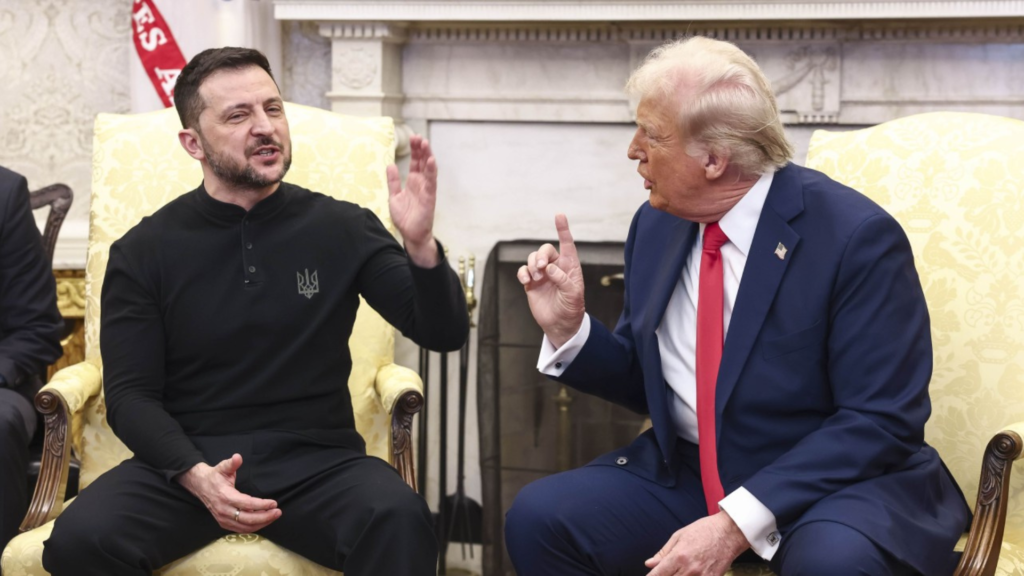
Volodymyr Zelensky met in Berlin with US Special Envoy Steve Witkoff and Jared Kushner to discuss a NATO-style security guarantee package for Ukraine, envisioned as the centerpiece of any potential peace agreement. US and European sources speak of “real progress” and a security framework that Trump would be willing to submit to the Senate for political backing, although the territorial issue and Vladimir Putin’s calculations remain the major obstacles.
Implications
The fact that Washington is pushing for a robust guarantee scheme for Kyiv confirms something essential: despite European weariness and missteps, the Atlantic axis has not given up on preventing Russian aggression from being rewarded with conquered territory, even though the final design of any armistice will require very complex balancing acts. That Witkoff and Kushner are at the center of this effort fits with a pragmatic Trumpian foreign policy, less rhetorical than that of the previous Biden administration and more results-oriented, as long as the red line of not legitimizing the use of force as a means of changing borders is maintained. A peace at “any price” would be a strategic victory for the Kremlin and a devastating message to Beijing in the Taiwan Strait; a firm peace, accompanied by credible military guarantees and the maintenance of targeted sanctions until there is effective restitution, can instead become an example of well-understood Atlantic realism.
3. Bondi: Islamic State-inspired jihadist massacre and journey to the Philippines
Facts
Two attackers—a father and son—opened fire on a Hanukkah celebration in Bondi Beach, Sydney, killing 15 people in Australia’s worst mass shooting in nearly three decades. Police have confirmed that the pair had traveled to the Philippines a month earlier, that the attack is being investigated as terrorism, and that improvised explosive devices and two homemade Islamic State flags were found in the son’s vehicle. Australian security sources suggest the trip was for military-style training in the southern Philippines, where ISIS-linked cells and networks continue to operate, despite Manila’s declaration years ago that the insurgency had ended.
Implications
This attack shatters the comfortable narrative of certain strategists in Washington and Europe, who relegate global jihadism to a “residual” threat while elevating to dogma the idea that the absolute priority is climate change, disinformation, or domestic extremism, depending on the day’s ideological whim. Reality is stubborn: the Islamic State has lost its territorial caliphate, but retains the capacity for transnational inspiration, training, and mobilization, from the Philippines to Africa, including radicalized cells or “lone wolves” in the West. The fact that the target was a Jewish community at a religious festival adds another layer: jihadist antisemitism feeds on the climate of hatred against Israel and Jews that has become normalized on some campuses, social media, and, all too often, in television studios and opinion columns where inflammatory rhetoric is tolerated if it comes wrapped in pseudo-anti-Zionism. Denying that jihadism remains a central threat is not just an analytical error: it is a moral irresponsibility.
4. AI and terrorism: the dark laboratory of the Islamic State
Facts
Recent reports warn that the Islamic State and other extremist groups are increasingly experimenting with generative artificial intelligence tools, from producing deepfakes to automating propaganda and potential uses in cyberattacks. Pro-ISIS forums have begun explicitly encouraging the incorporation of AI into their operations, highlighting its ease of use and its potential for recruitment, disinformation, and, in the medium term, even assisting in the manufacture of biological or chemical weapons, according to warnings gathered by Western intelligence agencies and organizations such as the U.S. Department of Homeland Security.
Implications
It is difficult to imagine a more disturbing combination than fanatics willing to commit mass murder and digital tools capable of fabricating perfect lies and multiplying them at breakneck speed. That a global agency refers to Islamist terrorist organizations as “militant groups” reveals the extent to which a certain political correctness has contaminated even the language of those who should be calling things by their names: terrorists, not “militants”; murders, not “security incidents.” This trivialization of terminology is not innocent: if terrorism ceases to be named as such, citizens become accustomed to seeing it as background noise, not as an existential challenge to our freedoms. Faced with this drift, the response must be twofold: to strengthen, without naiveté, the regulation and control of AI applications in the hands of malicious actors, and at the same time maintain a clear political and media discourse that neither whitewashes nor relativizes those who use these tools to sow terror.
5. The US and drug-running boats: narcoterrorism treated as a strategic threat
Facts
In recent months, the Trump Administration has intensified a campaign of military attacks against vessels suspected of transporting cocaine from Colombia and Venezuela to the United States, linked to cartels and insurgent groups such as the ELN. Several dozen deaths have already been reported in at least twenty operations in the Caribbean and Pacific, which Washington frames as part of its designation of the major cartels as terrorist organizations. Meanwhile, in Colombia and other countries, the legality of some of these actions and potential civilian casualties are being debated. At the same time, European media outlets are questioning the “legality” of these attacks in terms of international law, while devoting far less coverage to the victims of the cartels and narco-terrorism in the region.
Implications
It is surprising—or perhaps not so much anymore—that some of the press, which for years has whitewashed Chavismo as a “Bolivarian project,” are now outraged by the destruction of narco-boats that are part of the circulatory system of the immense mafia organization that is today the Caracas regime. The same people who dismiss the ELN or the FARC as “armed groups” are quick to criminalize any use of legitimate force against those who traffic tons of cocaine and control territories through terror and corruption. Treating them as “combatants” is not an exaggeration; it is an accurate description of their hybrid nature: they are drug traffickers and they are terrorists, and that is how they must be confronted, with legal scrutiny, yes, but without complexes or irresponsible sentimentality. At this point, Trump’s hardline policy, with all its debatable aspects, marks a healthy contrast with years of Western ambiguity regarding the narco-ecosystem that sustains Chavismo and its regional allies.
6. Spain: scandals, Sánchez’s policies, and the dignity hanging in the balance after some resignations
Facts
The international press is increasingly reporting on scandals affecting the Socialist Party and Pedro Sánchez’s government, ranging from corruption cases to accusations of sexual harassment and prostitution against prominent figures in the president’s inner circle. Analysts point out that the image of a “feminist government” and champion of reform has crumbled in the face of a cascade of accusations and opaque management, while social and political discontent grows, and criticism mounts over a distribution of positions perceived as patronage-based and partisan.
Implications
Given the current crisis, the continued tenure of certain high-ranking officials—including ambassadors appointed based on ideological affinity rather than professional merit—has become a political obscenity and an insult to the dignity of public service. The fact that some have “come out of the ideological closet,” proclaiming themselves lifelong leftists to secure a mission leadership position for which they would never have been considered under a genuine merit-based system, illustrates the extent to which the Sánchez administration has transformed parts of the government into spoils of partisan warfare. This is no longer a matter of ideological disagreement, but of basic decency: in any serious democracy, the accumulation of scandals and contradictions between feminist rhetoric and internal practices would have triggered a wave of resignations. In Spain, however, too many civil servants in positions of responsibility seem to have decided that career advancement and privileges outweigh honor.
7. Spanish and European security in the face of the resurgence of global jihadism
Facts
Recent reports and coverage of ISIS activity in the Philippines, the Middle East, and Africa underscore that the group continues to operate through decentralized networks and franchises, capable of inspiring attacks in third countries, as seen in Bondi. At the same time, the security strategies of some European powers and the US increasingly prioritize combating internal “extremism,” climate change, and great power competition, relegating Islamist terrorism to a secondary position in the threat hierarchy.
Implications
Europe would be ill-advised to forget the lessons of Madrid, London, Paris, and Brussels, lured by the illusion of a few years of relative calm. Jihadism, as the Philippines, the Sahel, and Australia itself clearly demonstrate, has not disappeared: it has mutated, decentralized, and is seeking new tools—from AI to cryptocurrencies—to sustain itself. Ignoring this reality for ideological reasons or because it disrupts certain discourses on multiculturalism is to hand ground to the enemy. Spain, given its geographical position and its own experience, should be at the forefront of a firm response, coordinated with its Atlantic partners and without hesitation in pointing out the destabilizing role of the Iranian regime and its proxies—Hezbollah, Hamas, the Houthis—within the jihadist and anti-Western ecosystem.
8. China: Persistent expansionism and an eye on Ukraine
Facts
While media attention is focused on Ukraine and the Middle East, Beijing continues to consolidate its position in the South China Sea, strengthening ties with actors in the Indian and Pacific Oceans—from Sri Lanka to the Maldives—and buying silence and loyalty in Africa and Latin America through debt, infrastructure, and privileged access to strategic raw materials. Think tanks and specialized media outlets indicate that the way in which the Russian-Ukrainian conflict is resolved—or not—will be closely watched by China as a barometer of the West’s willingness to defend the status quo in Taiwan and other gray areas.
Implications
If Russia manages to extract significant territorial concessions in Ukraine, the message to Beijing will be unequivocal: with enough patience, limited military pressure, and hybrid warfare, the Western bloc will eventually capitulate. Therefore, the ongoing negotiations, however necessary, cannot be interpreted as an implicit acceptance of conquest by force. Monitoring Chinese expansionism is not a hawkish obsession; it is simply geopolitical common sense in defense of a rules-based order. Europe, too focused on its domestic debates and the noise of internal power struggles, risks waking up too late to the fact that, while it flagellates itself, China is buying ports, mines, and strategic assets across the globe.
9. Latin America: Chavismo, drug trafficking, and the selective blindness of certain newsrooms
Facts
Venezuela’s role as a logistical and political hub for regional drug trafficking and dangerous alliances with Iran and its proxies has been documented by numerous investigations, while the Nicolás Maduro regime clings to power through repression, electoral fraud, and control of strategic resources. However, many Western media outlets continue to devote more space to criticizing the security policies of center-right governments than to highlighting with equal force the narco-dictatorial nature of Caracas or the authoritarian drift of allies like Nicaragua and Cuba.
Implications
There is an unbearable paradox in seeing impassioned editorials condemning the “excesses” in the fight against drug trafficking while aseptic, almost bureaucratic language is used to describe the atrocities of regimes that are, quite literally, mafia organizations with a seat at the United Nations. At this point, continuing to refer to Chavismo as the “Bolivarian government” or to Cuba as a “revolutionary regime” is not naiveté, it is narrative complicity. Anyone who truly cares about human rights in Latin America should applaud, with some nuance, any initiative that weakens the narco-terrorist networks that fuel the machinery of Caracas, Havana, or Managua. Anything else is moralistic rhetoric in service of the status quo.
10. The culture war and language: “militants”, “incidents” and other euphemisms
Facts
In recent years, a trend has emerged in some parts of the global press that avoids terms like “terrorist,” “jihadist,” or “radical Islamist,” preferring instead to use “militants,” “extremists,” or even “armed activists” when referring to organizations such as the Islamic State, Al-Qaeda, or their affiliates. At the same time, certain ideological frameworks—such as Wokism, cultural relativism, and a particular brand of identity politics on the left—have influenced headlines, approaches, and analyses in a significant number of influential newsrooms, from New York to London, and from Paris to Berlin.
Implications
Words are not neutral. When an international agency calls a group that beheads, enslaves, and massacres civilians a “militant organization,” it is contributing—whether it intends to or not—to diluting the gravity of the phenomenon. And when the focus shifts obsessively to Western shortcomings, while minimizing or relativizing the crimes of dictatorships and terrorist groups, it is taking sides in the culture war, even if it is presented as “neutrality.” Faced with this trend, it is essential to recover a clear editorial line: an unequivocal defense of representative liberal democracy, the rule of law, and the market economy; a firm rejection of terror—wherever it comes from—and zero tolerance for the euphemisms that whitewash it.
III. MEDIA RACK
– NYT / Washington Post / CNN / BBC:
– Focus on the Ukraine negotiations, with emphasis on the pressure on Zelensky to accept difficult compromises and on doubts about Putin’s willingness to reach a real agreement.
– Extensive coverage of Bondi, highlighting the trip to the Philippines and the anti-Semitic dimension of the attack, but with some terminological caution when delving into the Islamist ideological component.
– WSJ / Financial Times / The Economist:
– A realistic reading of the conflict in Ukraine, underlining the economic cost of a prolonged war and the need for a security framework that deters Russia without disarming Ukraine.
– Concern about the systemic risk of AI in the hands of malicious actors, with emphasis on the economic dimension and the vulnerability of critical infrastructures.
– Le Monde / Le Figaro / FAZ / Die Welt / Die Zeit / The European mainstream:
– Detailed monitoring of the talks on Ukraine and the internal European debate on sanctions and military aid, with tougher positions in the conservative German press than in certain French media outlets.
– Increasing coverage of scandals in Spain, presented as an erosion of the credibility of Sánchez’s government and as an example of citizen fatigue with corruption and moral inconsistency.
– Reuters / AP / AFP / DPA:
– Balanced series of pieces on Bondi, the journey to the Philippines and the trail of the Islamic State, with key details on flags, explosives and the links of the Mindanao region to jihadist networks.
– Reports on the experimentation of extremist groups with AI, pointing out both the threat of propaganda and disinformation and the risk, still incipient but real, of support for the manufacture of unconventional weapons.
– Ibero-American media (Clarín, El Mercurio, Reforma, etc.):
– A nuanced reading of Kast’s victory, highlighting more the public’s weariness with insecurity and the economic crisis than the “far right” label that dominates in Europe.
– Attention divided between migratory pressure, endemic corruption and the destabilizing role of drug trafficking, with constant references to Venezuela as a factor of regional disorder.
– Gulf and Arab world media (Al-Jazeera, Al-Arabiya, Asharq Al-Awsat, Saudi and Emirati press):
– Extensive coverage of the Gaza and Yemen fronts and the role of Iran, with significant differences in approach between media aligned with Doha and Tehran and those close to Riyadh and Abu Dhabi, the latter being much more critical of Iranian proxies.
– Israeli and Ukrainian press (Haaretz, Jerusalem Post, Kyiv Independent, Ukrinform):
– Concerned analyses about the precedent that any agreement with Russia could set for the balance of deterrence against Iran and other revisionist actors.
– In the case of Ukraine, insistence that any forced withdrawal from conquered territories would amount to a strategically and morally unacceptable capitulation.
IV. GEOPOLITICAL RISK TRAFFIC LIGHT: RISK MATRIX
🔴 Red (Critical)
• Global Jihadism 2.0 (Bondi + AI): Combination of attacks “inspired” by the Islamic State (such as the one in Sydney) and a qualitative leap in propaganda and disinformation capabilities through the use of Artificial Intelligence to radicalize “lone wolves”.
• Narco-terrorist drift and consolidation of Chavismo as a regional mafia axis: Reinforced while attention is focused on other theaters; however, the designation of the Cartel of the Suns as “terrorist” by the U.S. raises the level of confrontation.
• Risk of a bad deal in Ukraine: That it de facto legitimizes Russian territorial aggression and sends a signal of structural weakness to China, especially with proposals for “free economic zones” that could compromise Ukrainian sovereignty.
🟠 Amber (Tall)
• Political stability in Chile: Conservative victories, such as Kast’s, will be subjected to media delegitimization campaigns and street pressure organized by the radical left, which maintains a mobilization infrastructure.
• Internal situation in Spain: Where the erosion of institutional credibility —aggravated by diplomatic clashes with Israel and corruption scandals— can translate into social disaffection and the growth of anti-system alternatives if there is no ethical reaction.
• Coherence of the Atlantic bloc: Threatened by corruption scandals in the EU (Mogherini case) that weaken Brussels’ moral authority in the face of the challenge from Russia and China, demanding that Europe assume unpopular costs.
🟢 Green (Opportunity)
• Progress –still fragile– in designing a framework of security guarantees for Ukraine: Recognizing its de facto membership in the Western space (Article 5 type guarantees) and partially correcting the errors of the post-Cold War era.
• Consolidation of a more robust approach to narco-terrorism in Washington: With kinetic attacks and legal measures that can structurally weaken the cartels and regimes that feed off drug trafficking.
• Emergence of conservative leaders in Latin America: Such as Kast in Chile, who, by joining the Milei axis, offer a democratic alternative, order and economic freedom in the face of exhausted left-wing populism.
V. EDITORIAL COMMENTARY
The year 2025 will close its doors not with a whisper, but with the thunderous collapse of old structures and the emergence of new realities. José Antonio Kast’s resounding victory in Chile is much more than an election result; it is the vindication of common sense in the face of a decade of ideological delirium. Chileans, subjected to the failed experiment of the October Revolution, insecurity, and economic decline, have opted for order, freedom, and private property with a resounding 58% of the vote.
This victory sends a resounding message to the entire hemisphere: people don’t want woke revolutions that impoverish them, nor do they want foundational constitutions written out of resentment. They want security to work, controlled borders, and a state that isn’t a prize for activists. Gabriel Boric and his allies in the Puebla Group have been defeated not by conspiracies, but by the reality of their own incompetence. Chile is back on the path to development, joining Milei’s Argentina in an axis of freedom that promises to rebuild the prosperity of the Southern Cone. But we shouldn’t get carried away; good governance and moderation are demonstrated by governing.
Simultaneously, on the old continent, the veil of moral superiority of the European bureaucracy has been torn away. The arrest of Federica Mogherini and the diplomatic collapse of Pedro Sánchez’s government in Spain expose the rottenness of a progressive elite that, under the guise of solidarity and multilateralism, has built networks of corruption and cronyism. That Israel, the only democracy in the Middle East, has been forced to sanction Spanish ministers for antisemitism is an indelible stain that illustrates the extent to which the Madrid government has lost its moral and strategic compass.
But freedom cannot defend itself. The terrorist attack in Sydney and Iran’s nuclear program remind us that evil exists and is active. In the face of this, the United States’ new stance toward the Venezuelan narco-regime—moving from paper sanctions to actual kinetic strikes against the Cartel of the Suns—is the dose of realism the free world desperately needed. The doctrine of “Peace through Strength” is not an option; it is a necessity for survival.
The world remains a dangerous place, but today, with the resurgence of strong leadership in Latin America and the renewed determination in Washington to confront the enemies of freedom, the horizon is clearer than ever. Western naiveté is over; the era of responsibility and the active defense of our values has begun.