By Gustavo de Arístegui, as published by La Razón, 19 April, 2026
Many of the ideological principles of Orbanism will remain on the Hungarian political agenda. What must disappear is an authoritarian style of government that subordinates institutions to the service of an individual and their inner circle.
Viktor Orban was an anomaly in the European center-right. And I do mean center-right, because it was in that political-ideological space that he began and completed his political movement, before a mutation—and note that I write mutation and not evolution, because the difference is not semantic but clinical—dragged him into territories increasingly uncomfortable for his former allies. Over time, Orban drifted—note also that I write drift and not change, because that distinction is not innocent either—towards the most hardline, Eurosceptic, pro-Russian, and profoundly destabilizing nationalist right. A trajectory that, seen in retrospect, cannot be described as an ideological conversion, but rather as a surrender to the crudest and most ruthless calculation of power.
But let’s not be fooled. Many of the tenets that, over time, seemed excessive and completely alien to the moderate, centrist, sensible, and balanced doctrine of European center-right parties—especially those belonging to the EPP and IDC families—found a receptive audience in Hungarian society at the time . The nationalism and patriotic pride of a people historically central to European history—and not only in the geographical sense—found undeniable appeal and a deep cultural affinity in Orbán’s rhetoric.
To this must be added the weight of a national identity forged through turbulent centuries: empires that crushed it, treaties that mutilated it—the Treaty of Trianon, which amputated two-thirds of Hungary’s historical territory, remains an open wound in the nation’s collective psyche—and regimes that subjugated it. Hungary is not just any country: it is a nation with a long memory, accumulated grievances , and an extraordinary capacity to recognize, in the discourse of power, those forms that history has taught it to fear.
It would be a grave misperception, with major strategic consequences, for Europe, the European Union, the Commission, and all member states to make a biased—and therefore completely erroneous—interpretation of what has happened in Hungary over the past sixteen years . There was no coup. There was no totalitarian drift imported from abroad. There were no rigged elections, however much some commentators, incapable of accepting that a European electorate might vote differently than they would like, might try to portray them that way.
A center-right politician won elections repeatedly with a message that resonated with Hungarians for a generation and a half. That is democracy. Perhaps uncomfortable for some armchair foreign ministers and editorial writers in Brussels who mistake their own discomfort for the illegitimacy of others, but democracy nonetheless. And to deny this is not to defend democracy: it is to replace it with prejudice.
What, then, are the reasons for their resounding defeat? The answer is as simple as it is uncomfortable for those who would complicate it with self-serving interpretations: It is not a shift to the left! However, most of the commentary and celebrations flooding the media these days come from left-wing political parties, leaders, and media outlets, who interpret the Hungarian result as their own victory, when in reality it is a defeat for others that they did not win. The Hungarian change is a change of style, respectful of the rules of the democratic game of the European Union, and an alignment with the other Eastern European countries—Poland, the Baltic states, Slovakia, the Czech Republic—that have a genuine and well-founded fear of Russian expansionism.
This is not an ideological shift: it is a course correction within the same political space. To confuse the two is, at best, ignorance; at worst, self-serving bad faith.
The pendulum has not swung back to the left. Nor will it in the near future. In fact, the pendulum in Europe is swinging to the right, and in many cases, too far to the right. Most of the left-wing parties that remain in power are those that follow moderate, social-democratic agendas: Denmark, with its Prime Minister Mette Frederiksen, who embodies this model of moderation, firm borders, strong social protection, and zero tolerance for radical Islam; Cyprus, Romania, and, further to the left of the spectrum, Slovakia, Slovenia, Malta, and Lithuania ; and far to the left of all of them, Spain, a special case deserving of its own analysis on another occasion.
The European map is clear when viewed in terms of population rather than headlines: approximately 370 million Europeans have elected center-right, conservative right-wing, or coalition governments with some form of far-right or nationalist party. In contrast, left-wing, center-left, and far-left governments represent a mere 85 million inhabitants. But no: the pendulum hasn’t swung back. Anyone who reads the map backwards is either manipulating the data or blinded by sectarianism.
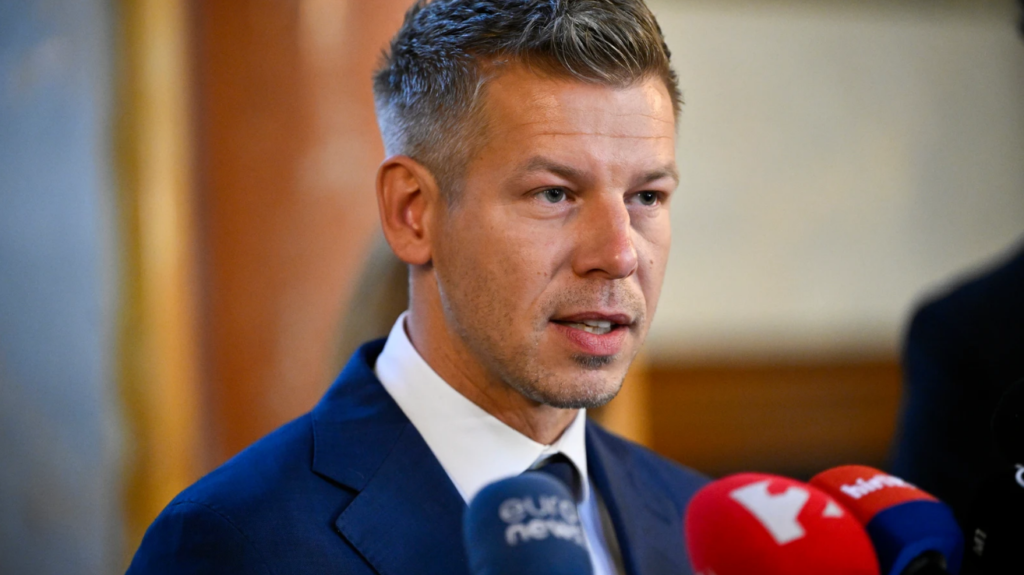
Peter Magyar—it’s worth remembering precisely, because some deliberately omit this in their self-serving confusion—comes from Viktor Orbán’s own party. He is a Hungarian nationalist conservative, pro-European, yes, but conservative nonetheless. His political emergence doesn’t represent the irruption of the left into the Hungarian public sphere, but rather an internal fracture within Orbánism, perfectly understandable given the authoritarian drift of the now former Hungarian prime minister. It’s a rebellion by a segment of the conservative electorate that grew tired of the man before the ideas. A distinction that the masters of easy headlines prefer not to make, because it ruins the narrative.
The Hungarians grew weary of the gradual encroachment upon and takeover of all the country’s democratic institutions—the executive branch, the administration, the judiciary, and even the media—and of a concentration of power that, in a parliamentary system where the legislature is already dominated by the majority, is simply suffocating, especially when that majority is a single party with no real checks and balances. The Hungarians did not vote for the left. They voted against a personalistic, authoritarian style of government , obsessively focused on perpetuating itself and twistedly geared toward serving an ever-shrinking circle of power. Does this model sound familiar? It should, because it is not unique to Budapest; it is very close to home, and it is important to recognize it before history forces us to do so under far more dramatic circumstances.
Many of the ideological principles of Orbánism will remain on the Hungarian political agenda, and it would be naive to assume otherwise. What must disappear—and this is what we can expect from the new cycle—is the style of government: the lack of respect for the separation of powers, the trampling of the judiciary, the invasion, conquest, domination, and subjugation of institutions to serve an individual and his inner circle. But I repeat, because it is important to repeat until it is understood: this is not a problem of ideology. Orbán veered sharply to the right because his personalistic and authoritarian style of government demanded it. Ideology was, to a large extent, the pretext. It was a matter of strategy, of style, of unbridled ambition, and of an insatiable hunger for power. And whoever confuses the pretext with the driving force behind the phenomenon is doomed to draw the wrong lesson.
Therefore, do not expect Hungary to open its borders tomorrow to uncontrolled immigration, to the “wokism” movement, or to the primitive , ridiculous, and ungrateful anti-Americanism that proliferates so much in certain European circles. Nor should JD Vance’s clumsy involvement in the Hungarian campaign be confused with the strategic interests of the United States. Vance himself complained bitterly at the 2025 Munich Security Conference about the support some European center-right leaders gave to Kamala Harris in the US presidential election. And he was absolutely right! First, ideologically: Kamala was, and still is, the antithesis of the European center-right.
His father was a notorious Marxist-Leninist, and his radical sympathies undoubtedly stem from misunderstood readings—if he ever actually read them, which is a big assumption. The support given to Harris by certain European leaders within our political sphere was a monumental miscalculation, and Vance was right not to let it go unpunished. It’s another matter that his recent strategy regarding Hungary has been equally clumsy, ill-timed, and geopolitically counterproductive; one doesn’t negate the other, and honest analysis requires acknowledging both extremes without bias or ulterior motives.
There are reasons for hope, but also for caution. We must hope that what comes next in Hungary will be, at the very least, a serious and rigorous analysis of Peter Magyar’s electoral platform and an even-handed assessment of his government program, not the mixture of premature celebration and ideological misgiving that is dominating European coverage these days, and which serves neither the truth nor anyone’s strategic interests.
The stubborn individuals on both sides are the true losers of last Sunday in Hungary, not just Orban: those who celebrate without understanding what has happened and those who weep without accepting what was inevitably coming. Between these two extremes, they lose the ability to read reality as it is, which is the only virtue that distinguishes the analyst from the propagandist.
What happened in Budapest is both much simpler and much more revealing than what is being reported. A democratic and proud people have grown tired of a leader who confused the popular mandate with lifetime ownership of the state, and who ended up embodying, even outside the center-right from which he came, precisely what the European center-right had fought against for decades: extremism of any color, shade, or excuse. Nothing more, and nothing less.
The rest is political noise for the domestic consumption of those who haven’t understood—and never will—that democracy doesn’t necessarily change course when a leader falls: it changes style, it recovers the sacred principles of democracy. And that, precisely that, is what has changed in Hungary. The rest—Hungarian conservatism, Magyar national pride, the geography of an Eastern Europe that rightly looks toward Moscow with apprehension —is back where it always should have been.