New Delhi Does Not Share the Russian Political Model. Its Democracy Brings It Closer to the West, but It Moves Away When It Feels Patronized
By Gustavo de Arístegui, Diplomat, as published by La Razón.
07.12.2025
The visit of Vladimir Putin to New Delhi, and the very warm welcome he received from Prime Minister Narendra Modi, has triggered a wave of simplistic interpretations in the West. But India — that extraordinary millennia-old democracy where gesture weighs as much as words — never acts on impulse. What we saw in Delhi is not an ideological alliance but a masterful exercise in strategic autonomy.
When I was Spain’s ambassador to that fascinating country, I was able to witness the immense symbolism of an embrace in a place where physical contact is almost taboo. It’s a huge mistake to interpret it without context.
A Reception That Speaks More Than a Thousand Speeches
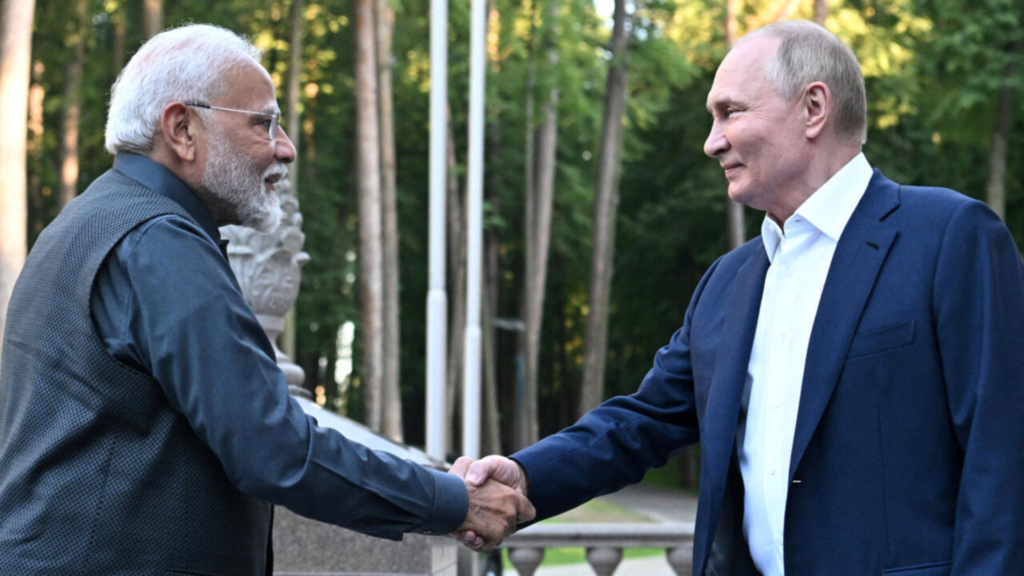
Anyone unfamiliar with the Indian political soul might think the scene was just another courtesy: Modi waiting for Putin at the airport runway, smiling, close, almost fraternal. But that reading forgets one fundamental fact: Indian political authorities never receive a foreign head of state at the airport. A minister or a senior official normally does. That it was Modi himself who awaited the Russian leader is an extraordinary gesture, loaded with symbolism.
That embrace was not improvised. It was a message addressed to Moscow, yes, but also to Washington and Europe: India makes its own decisions and accepts pressure from no one. Indian protocol — solemn, measured, meticulous — rarely errs. And when it is altered, it’s because someone wants the world to listen.
The Long Memory: Russia as India’s Historic Ally
The Indo-Russian link was not born yesterday. It was forged in 1947, when newly independent India sought allies who did not intend to turn it into a pawn of the Cold War. The USSR supported New Delhi at key moments — from Kashmir to wars with Pakistan, through accelerated industrialization and building strategic capabilities.
That historical loyalty remains very present in Delhi. This is not nostalgia, but a recognition that Russia never humiliated India, never pressured it, never conditioned its sovereignty. That memory is part of the explanation for why Russia still holds a privileged place in the Indian political imagination.
But it must also be said clearly: today’s Russia is not the USSR of 1971. Moscow is the aggressor in Ukraine, and India knows it. Its silence, unfortunately, is not complicity but calculation. New Delhi maintains its connection with Russia not because it endorses its actions, but because it is in India’s interest to keep all channels open to guarantee its autonomy.
Realism, Not Alignment: India’s Compass Doesn’t Turn Eastward, but Again Toward Itself
Despite historical sympathy toward Moscow, India does not share the Russian political model. Its democracy — complex, overwhelming, boundless — brings it much closer to the West than to any authoritarian power. The strength of its press, the vitality of its civil society, the robustness of its market economy, and the size of its diaspora in the United States and Europe speak for themselves.
What distances India from some Western partners is not values, but the tendency to confuse cooperation with tutelage. From Nehru through Modi, including Indira Gandhi, Vajpayee, and Manmohan Singh, India has always firmly rejected any alliance that implies subordination. The country wants partners, not masters; agreements, not constraints; shared interests, not obedience.
That is why India will not accept becoming “the blocker of China for the West.” Its goal is not to serve as a wall, but to strengthen its autonomous capacity to confront China and Pakistan, the two challenges that truly occupy its security horizon.
Russian Energy and Oil
One of the pillars of the visit was energy. Putin guaranteed “uninterrupted supplies” of oil for India, a message that outlets like Al Jazeera and the BBC rightly emphasized. For a country of 1.4 billion people whose growth depends on energy stability, discounted Russian crude is an authentic economic safety valve.
That decision — to buy discounted oil — is not ideological. It is pragmatic. Responsible. Strategic. A power destined to decisively influence the Eurasian balance must ensure that its energy pragmatism does not, even indirectly, bring it closer to actors who erode global stability.
The Imperfect Triangle: Washington, New Delhi, and the Tariff Misstep
What has done the most harm to the India-United States relationship in recent months has not been New Delhi’s policy, but Washington’s clumsiness. President Trump — usually cautious on foreign affairs — made a serious mistake by imposing punitive secondary tariffs on India for buying Russian oil. Nothing irritates the Asian giant more than such unilateral sanctions, perceived as unnecessary humiliations.
If the goal was to pull India away from Moscow, the opposite has happened: it has strengthened the Indo-Russian bond, symbolized emphatically in this visit.
Added to this is a significant diplomatic blunder: the appointment in New Delhi of an ambassador too young, without the training or experience needed, and with overconfidence due to his closeness to the U.S. president’s children. A country like India, where seniority and hierarchy are essential to the perception of respect, does not tolerate such frivolities. These are not anecdotes; they are affronts.
Military Cooperation: Tradition, Technology, and Managed Dependence
Russia remains the backbone of the Indian arsenal: from Su-30MKI fighters to T-90 tanks, through air defense systems, warships, and the famous BrahMos missile — an example of successful codesign. That dependence is not sentimental; it is structural. Logistics, spare parts, doctrine, and interoperability are still largely Russian.
France holds a growing place — with Rafales, Scorpènes, and future Rafale-M aircraft — and the United States advances in intelligence and maritime cooperation. But replacing decades of Russian dependence cannot be achieved in five years. Or even two. That is why India will not break with Moscow. It cannot afford it. But it will not align with Moscow’s international agenda either. It does not want to. That distinction is key to not reading Putin’s visit as an irreversible strategic shift.
Symbolism vs. Strategy: The True Nature of the Visit
The warm reception Modi gave Putin could be interpreted as a rebirth of the Indo-Russian alliance. But reality is more complex. What we saw was a gesture charged with history, yes, but also a circumstantial response to U.S. pressure.
New Delhi wanted to make it clear that:
- It does not accept sanctions that violate its economic autonomy.
- It does not tolerate behavior lessons from anyone.
- It maintains freedom of action as an inviolable principle.
The welcome extended to Putin should be interpreted in its historical context and in gratitude to someone who always supported India even in the most difficult moments. The warmth and gestures of deference to Putin do not mean in the least that India is leaning toward Moscow in this new Cold War. India insists repeatedly that it is beholden to no one.
India does not believe in alliances, because as its most respected theorists say, “where there is an alliance there is a principal and a subordinate — and India is subordinate to no one.” And that nuance, so Indian, is something the West still fails to understand.
Conclusion: Understanding India Requires Respect, Knowledge, and Humility
India is a formidable, proud, open, vibrant democracy; an emerging economic and technological power; not an emerging power anymore, but a driving one. India is a pillar for stability in the Indo-Pacific; an essential partner — not a subordinate client — for Europe and the United States. But it is also a civilization that does not accept pressure, despises condescension, and values independence above all else.
As said, the warm reception for Putin is not, by any means, an anti-Western turn. Nor is it an eternal strategic embrace. It reflects, in the language of Indian protocol, that India cooperates with those who respect it… and resists those who pressure it or, worse, try to humiliate it.
The West would do well to take note. Misreading India leads not only to diplomatic errors but, worse, strategic ones. India placed on the wrong side of history will change the story of what remains of the twenty-first century. If India is respected and valued for what it contributes to humanity, global security, and peace, it will unquestionably be a central element of worldwide peace and prosperity.