Analysis by Gustavo de Arístegui, as published in El Debate, 18 February 2026
Iran has turned nuclear ambiguity into a tool of power. It negotiates when it feels weak, advances when it detects hesitation in the West, and uses diplomatic pauses to expand its technological capabilities.
The Iranian regime today constitutes one of the most serious threats to international security, not only because of its nuclear ambitions but also because of its openly jihadist and terrorist nature. Its foreign policy combines regional expansion with the export of terror, while domestically it imposes a system of total repression where dissent is punished with imprisonment, torture, or death.
Understanding Iran requires looking at both its underground nuclear laboratories and its prisons full of women, students, and journalists whose only “crime” is demanding freedom and dignity.
The myth of the civilian program
For years, Tehran has maintained that its nuclear program is exclusively for civilian purposes. The evidence contradicts this. While electricity generation programs only require uranium enriched to 5 or 6%, Iranian centrifuges are designed to reach levels exceeding 90%, the threshold necessary for manufacturing nuclear weapons.
The International Atomic Energy Agency has documented the existence of hundreds of kilograms of uranium enriched to 60-70%, material that could be quickly converted for military use and which the regime apparently secured before the US and Israeli attacks.
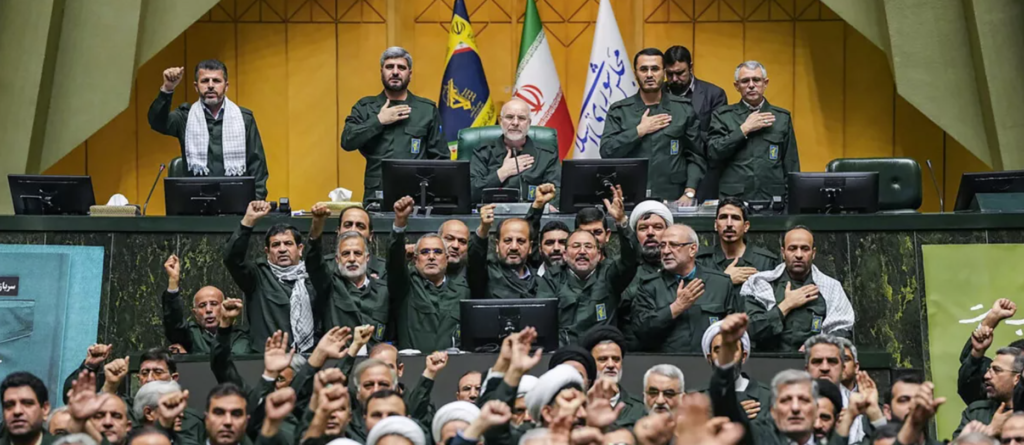
Even more revealing is who controls the program: not the Ministry of Energy , but directly the Supreme Leader and the Islamic Revolutionary Guard Corps , the true core of the jihadist and terrorist regime. If it were a civilian project, it would be under technical supervision and public scrutiny; however, its militarized structure confirms that the intentions are quite different.
Added to this is the location of the main facilities, excavated hundreds of meters underground and fortified like war bunkers. No power plant needs such protection. Only a military-grade industry designed to survive an attack justifies such architecture.
A policy of force and blackmail
Iran has turned nuclear ambiguity into a tool of power. It negotiates when it feels weak, advances when it detects hesitation in the West, and uses diplomatic pauses to expand its technological capabilities. Its objective is not open war, but rather the consolidation of a threshold nuclear status that allows it to threaten and blackmail Israel, Arab countries, and ultimately the entire international community, thus securing the existence of its execrable regime, much like the bizarre and bloodthirsty North Korean regime.
We are not talking about a conventional state, but a jihadist and terrorist regime that combines expansionist ambition, religious fanaticism, and absolute internal repression. Abroad, it finances, trains, and directs terrorist organizations such as Hezbollah, Hamas, the Houthis, and the Shiite militias of Iraq and Syria ; domestically, it crushes all opposition. This dual dynamic makes Iran a transnational actor of terror and destabilization.
That is why the international response cannot be limited to diplomatic gestures. Every concession to the regime translates into a new, covert advance. Only sustained pressure—economic, political, and intelligence-driven—accompanied by real monitoring can halt the nuclear program. Iran must renounce enrichment beyond civilian levels, suspend the development of long-range missiles, and stop using its terrorist proxies as weapons against its enemies. Everything else is just
an excuse to buy time.
A future of “no peace”
The most likely outcome is a calculated “no-peace”: Iran will alternate threats with supposed gestures of cooperation to keep the international community divided. Meanwhile, it will continue advancing its centrifuge technology and its ballistic and hypersonic missile industry, as well as its bloody network of terrorist groups. If the West succumbs to fatigue or diplomatic naiveté, the result will be a nuclear Iran, an unacceptable threat to the
International community
This prospect is incompatible with regional stability and global free trade. A nuclear Iran would trigger an arms race in the Middle East. Preventing this requires three things: unity among democratic powers, a credible threat of the legitimate use of force, and decisive support for Iranians within the regime who are challenging it.
Narges Mohammadi: symbol of resistance
While developing its power projects, the jihadist and terrorist regime in Tehran maintains its barbaric internal repression. Narges Mohammadi , Nobel Peace Prize laureate, is a symbol of those who refuse to submit. A human rights activist and opponent of the death penalty, Mohammadi has been imprisoned time and again; today she completes seven and a half years in prison under inhumane conditions. Her “crime”: demanding freedom and equality for Iranian women.
The Nobel Committee has officially called for his release, denouncing cruel and degrading treatment. However, the international response has been, to a large extent, complicit silence. In major Western capitals, lukewarm statements and diplomatic evasions abound, but genuine action is lacking. Certain left-wing groups that passionately mobilize against injustices in the West remain silent when the perpetrator is anti-Western. It is pure, repugnant hypocrisy.
The cowardice of relativism
This silence reveals a moral pathology: measuring injustice by who commits it, not by who suffers it. The West takes refuge in the euphemism of “constructive dialogue” to avoid admitting that it is negotiating with a jihadist and terrorist regime. But the facts are stubborn: homosexuals are murdered, flogged, tortured, and hanged from cranes, and women, trade unionists, and religious minorities are imprisoned and tortured simply for thinking differently. It is profoundly immoral not to denounce this.
The contrast between young Iranians risking their lives for a horizon of freedom and the indifference of much of our political class is glaring. While women are imprisoned in Tehran for removing their veils, Western universities trivialize debates about minor identity offenses. This moral dissonance speaks volumes about our times: the noise of the trivial drowns out the voices of what is essential.
And yet, hope persists. In recent days, several European capitals—especially Berlin—have seen massive demonstrations in support of the Iranian people. Between 200,000 and 250,000 people marched for freedom and justice, a reminder that the European moral conscience is not entirely dormant.
Ethics, strategy and the future
Talking about Iran is not just talking about geopolitics. It’s talking about our collective capacity to distinguish good from evil, freedom from fear. Resisting nuclear blackmail and supporting Iranian democrats is not altruism: it’s self-defense for the free world.
Every time a Western leader receives emissaries from Tehran with honors without mentioning Mohammadi or the victims of the regime, they send a message of capitulation. No energy agreement or tactical calculation is worth more than the principles that underpin our democracies. History teaches that moral cowardice always comes at a very high price.