What is happening in the United States foreshadows a trend that is beginning to emerge in other Western democracies.
By Gustavo de Arístegui, as published by La Razón, 28 April, 2026
The United States is experiencing its most severe phase of internal division since the end of the Civil War . The American Republic, born of Reconstruction and admired for generations, is now showing unmistakable signs of structural fatigue and a growing social tolerance of political violence when it is directed against figures on the right and center-right.
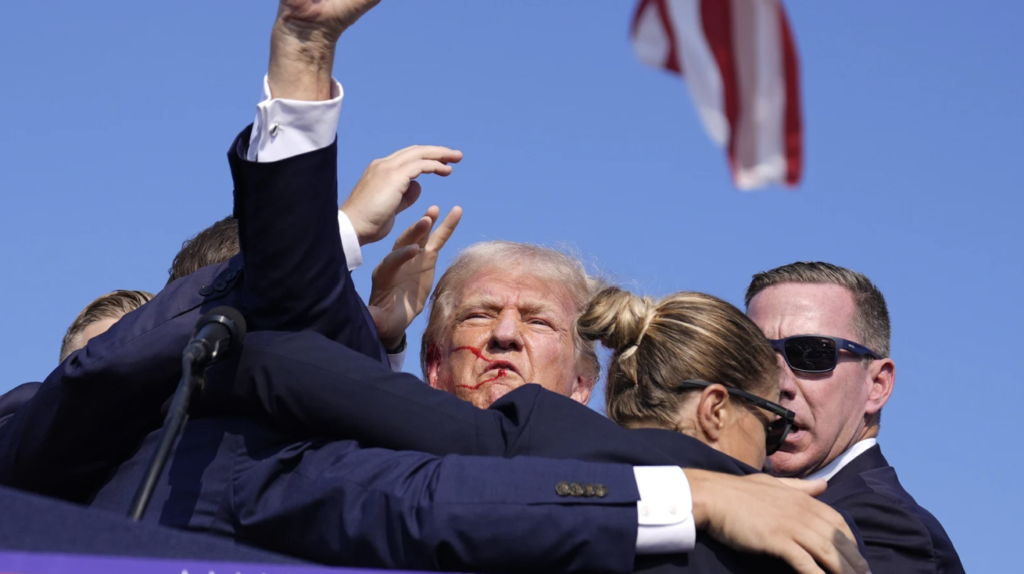
The chronology is now unequivocal. The two previous foiled assassination attempts against President Donald Trump in 2024 —the one in Butler, Pennsylvania, in July, where Thomas Crooks’ bullet wounded him in the right ear and killed former fire chief Corey Comperatore; the one at Mar-a-Lago in September, where Ryan Routh staked twelve hours with an SKS rifle aimed at the golf course; the completed assassination of Charlie Kirk in September 2025; and this past Saturday, April 25, the foiled attempt against Trump himself, the First Lady, Vice President Vance, and Cabinet members at the White House Correspondents’ Dinner at the Washington Hilton Hotel.
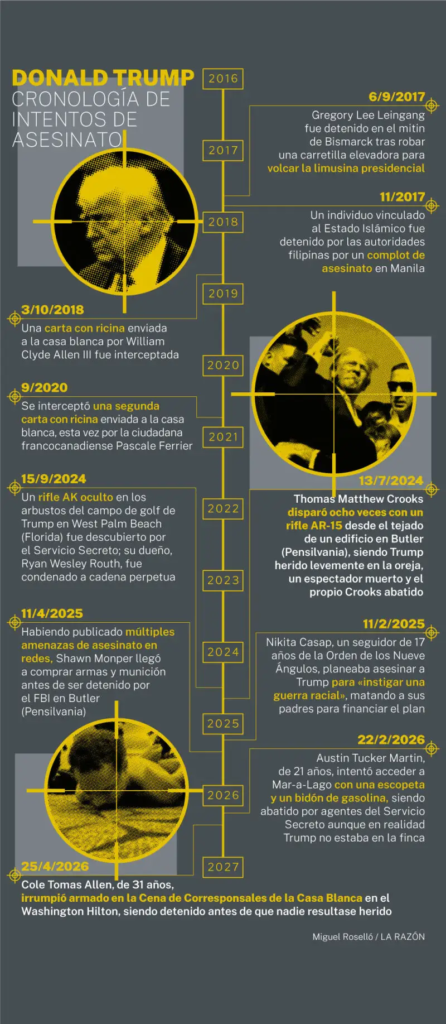
Assassination attempts against Donald Trump by Miguel Roselló, La Razón
Cole Thomas Allen, a 31-year-old Californian, stormed through the Secret Service cordon armed with a shotgun, pistol, and several knives, calling himself a “Friendly Federal Assassin” in his manifesto and announcing his intention to assassinate members of the Trump administration. Because behind Crooks, Routh, Robinson, and Allen lies a pattern that polls reflect in a terrifying way. A study by the Network Contagion Research Institute at Rutgers University, published in April 2025 on a weighted sample of 1,264 citizens, revealed that 55% of self-identified center-left voters consider the assassination of President Trump “at least in some way justified”; 14.1%, “completely justified.” We’re not talking about the fringe extremists: we’re talking about the average Democratic voter, the regular reader of the New York Times or the Washington Post. British political scientist Eric Kaufmann, applying the rigorous technique of the list experiment, which neutralizes social desirability bias, established that 70% of Democratic voters “were glad that Butler’s assassin failed.” Yes, only seven out of ten. And the Rasmussen/Napolitan poll following the foiled Mar-a-Lago attack documented that
more than 25% of Democratic voters explicitly believe that the United States “would be better off with Donald Trump assassinated.” A level of tolerance for violence has been reached in the US that has not been seen for decades.
There is an equation, known since Cicero and rigorously reformulated by Gordon Allport in *The Nature of Prejudice* (1954): hateful thoughts breed hateful words, and hateful words eventually translate, in vulnerable minds, into hateful acts. This is not a mechanical deduction; not everyone exposed to inflammatory rhetoric will pull the trigger, but rather a matter of statistical probability. Studies on Rwanda, the former Yugoslavia, and the pogroms against the Rohingya in Myanmar are unequivocal.
The problem in America is that this equation is applied in a structurally asymmetrical way. While the conservative press—Fox News, The Wall Street Journal, The Daily Wire, Newsmax—harshly criticizes its adversary and, on the fringes, undoubtedly resorts to demagoguery far too often, a substantial part of the so-called progressive media ecosystem—MSNBC, now renamed MS NOW, the undisputed leader in this sinister ranking; The Washington Post until its recent reorganization; The Nation, The New Republic, The Guardian; the hard left of Jacobin and CounterPunch; the digital outlets Salon, Slate, HuffPost, and Daily Beast; and, on social media, the ultra-radical Bluesky— has normalized the systematic equation of the Republican Party with historical fascism, the MAGA voter with the Nazi militant, and conservative leaders with criminals who deserve to “suffer serious consequences.” In 2022 alone, MSNBC used the words “fascism” or “fascist” 1,614 times, according to the aggregator Grabien Media. In October 2024, the same outlet drew a parallel between Trump’s rally at Madison Square Garden and the pro-Nazi rally held there in February 1939. Following Kirk’s assassination, MSNBC analyst Matthew Dowd claimed live on air that the activist was responsible for his own death because of his “hate speech.” And after the Hilton attack, Bluesky was filled with messages shamelessly suggesting that the attack had been staged by Trump himself.
It’s important not to fall into the opposite trap. Political violence in the United States is not the sole domain of any one side: the storming of the Capitol on January 6, 2021, was a very serious coup attempt, unequivocally condemnable. But the decisive difference lies in the response of the majority of the conservative camp, which condemned the attack without reservation.
And here’s the lesson we Europeans, and especially we Spaniards, must learn. The American divide isn’t an American problem; it’s a Western problem. Data from the Pew Research Center, the European Social Survey, and major observatories all converge on the fact that affective polarization is on the rise in all mature democracies. Spain, in some indicators, shows levels comparable to or even higher than those in the United States. The difference with Washington isn’t one of nature, but of phase. If our media figures continue to call the democratic adversary a “fascist,” if our responsible leaders don’t disavow the extremes within their own camp, then prepare yourselves to experience what the Americans are already living through. Before the Mauser rifle that murdered Charlie Kirk—and before the shotgun of the “Friendly Federal Assassin” at the Hilton—there were ten years of public discourse according to which Trump and Kirk were “fascists” who deserved “consequences.” Not everyone exposed to hate speech fired a shot. But someone did. That is the correlation that the political classes (formerly elites) have a moral obligation to recognize, before it is too late.