By Gustavo de Arístegui, as published by La Razón, 30 March, 2026
The military campaign has decapitated the Iranian regime, but secret diplomacy is searching for an interlocutor amidst the ruins of power.
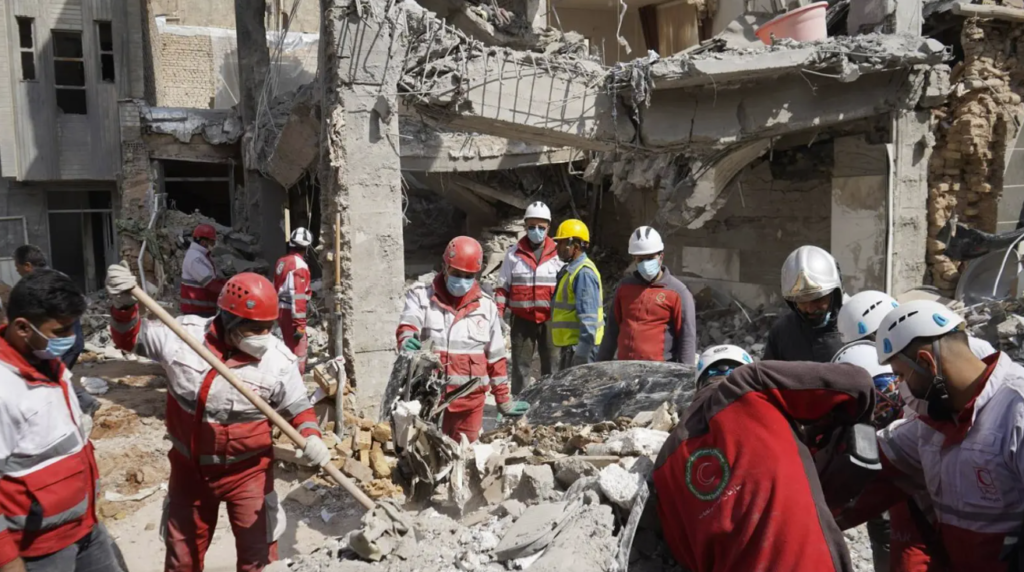
Nearly a month after the start of Operation Epic Fury/Roaring Lion—the joint US-Israeli military campaign against Iran’s military and nuclear apparatus —the strategic landscape of the Middle East has undergone an unprecedented transformation. The elimination of Ali Khamenei, Ali Larijani (secretary of the Supreme National Security Council), Intelligence Minister Esmail Khatib, and numerous other high-ranking officials has left the regime leaderless . More than 9,000 high-value strategic targets have been struck; Iranian ballistic missile attacks have fallen by nearly 90 percent, and drone strikes by more than 80 percent. Both navies—the Islamic Revolutionary Guard Corps (IRGC) and the regular navy—have been virtually annihilated.
Amid this devastation, something seemingly contradictory is happening behind the scenes: Washington and Tehran are holding indirect talks . This is not an anomaly; it is the logical consequence of war. When a regime collapses, diplomacy doesn’t disappear; it becomes clandestine, nervous, and brutally pragmatic. Secret diplomacy is born from the ruins, manages the debris, and tries to prevent the collapse from turning into a regional conflagration.
THE MILITARY CAMPAIGN AND THE WEAKENING OF THE REGIME
The blows did not begin on February 28, 2026: they have been accumulating since the implosion of Bashar al-Assad’s regime in Syria—which was, as Karim Sadjadpour (Carnegie Endowment for International Peace) has pointed out, the land bridge connecting Iran with the terrorist organization Hezbollah and the Mediterranean—, the elimination of Hassan Nasrallah, the weakening of Hamas after the Gaza war, and the June 2025 attacks against Iranian military and nuclear infrastructure.
But above all these factors, what has truly fractured the Islamic Republic has been the massive popular uprising of the heroic Iranian people : the protests that erupted in late 2025 and escalated dramatically in January 2026, with human rights organizations estimating more than 30,000 deaths. An Iranian prisoner of conscience—with another nationality—imprisoned for years in the infamous Evin Prison, whom we will call Hussein—not his real name—presented me with a powerful and profoundly accurate thesis in a conversation on March 20, 2026: the Iranian regime is brutal, heartless, and ruthless, but it is not impossible to defeat . This is a complete rebuttal to the great analytical error of many Western governments, which have confused longevity with strength.
A LOOK AT THE REGIME FROM WITHIN: CORRUPTION AND DIVIDE
Hussein’s testimony illuminates the true nature of the interlocutor with whom Washington is attempting to negotiate. The ayatollahs’ regime is not a theocracy; it is a jihadist oligarchy . Religion is not its essence, but its alibi: the sacred trappings of a mafia-like, extractive, and fiercely repressive structure. They have built a mammoth bureaucracy that employs fifty percent of the population, yet they cannot garner more than fifteen percent support. The state apparatus is inefficient, incompetent, monstrously expensive, and, above all, cosmically corrupt. The country’s economic ruin is not due to sanctions: it is a direct consequence of the systematic plundering by a nomenklatura that has transformed the revolution into a vast criminal enterprise.
Negotiating with a regime whose true driving force is corruption is, paradoxically, easier than negotiating with suicidal fanatics. The corrupt want to preserve their wealth and their lives; the fanatics do not. Washington knows this. Both sides know that, when a regime enters its terminal phase, the instinct for self-preservation often outweighs ideological purity.
INDIRECT NEGOTIATIONS: ACTORS, MEDIATORS AND SCENARIOS
The US delegation
The US negotiating team could be headed by Vice President JD Vance, accompanied by Steve Witkoff, Trump’s special envoy, and Jared Kushner, the president’s son-in-law and likely successor to Witkoff.
The apparent Iranian interlocutor: Mohammad Bagher Ghalibaf
Herein lies the keystone of the process. Trump declared on March 23 that the United States is “negotiating with a man who I think is the most respected—not the supreme leader, we haven’t heard from him,” adding that he didn’t want to name him “because I don’t want him to get killed.” Multiple media outlets—Axios, Politico, Israeli publications—have identified this interlocutor as Mohammad Bagher Ghalibaf (or Qalibaf), the speaker of the Iranian Parliament. I myself named him in various media outlets almost two weeks ago.
Ghalibaf is the figure on whom Hussein drew particular attention: a former IRGC general and head of its Air Force, head of the Republic’s Police, mayor of Tehran for twelve years, and speaker of Parliament since 2020. Arash Azizi, of Yale University, considers him probably the most powerful man in Iran right now. He perfectly embodies the mix of fanaticism and corruption that defines the regime: he faces serious accusations—including funneling three and a half million dollars to a foundation run by his wife—yet he attended Davos, told the Financial Times that he admired New York, and said to the London Times in 2008: “I would like the West to change its attitude toward Iran.”
Hussein warned me: “If Ghalibaf is eliminated, I don’t know what might happen next. It could be even worse.” This is the “decapitation paradox”: each elimination reduces the regime’s capacity to inflict harm, but also the number of interlocutors with sufficient authority to negotiate a transition . Hence, at Pakistan’s request and with the acquiescence of the United States, Israel has temporarily removed Ghalibaf and Foreign Minister Araghchi from its list of military targets.
The place: Pakistan (Islamabad)
On March 26, 2026, Pakistani Foreign Minister Ishaq Dar confirmed that “indirect talks between the United States and Iran are taking place through Pakistan.” Prime Minister Shehbaz Sharif and the country’s de facto strongman, Field Marshal Asim Munir—who spoke with Trump the previous Sunday—are directly involved.
The mediators: real and self-proclaimed
There are three actual mediators: Pakistan, officially confirmed; Oman, which mediated in the pre-war rounds (Muscat in February, Geneva on February 26) and whose minister, Badr bin Hamad Al Busaidi, acted as the conduit between Witkoff-Kushner and Tehran; and Qatar, a historical partner in regional mediations . Egypt has also joined the effort, with Foreign Minister Badr Abdellatty having spoken to both sides and publicly declaring his support for Trump’s initiative. Among the self-proclaimed mediators, Turkey stands out.
TRUMP’S FIFTEEN POINTS
The US proposal, transmitted through Pakistan, includes: a 30-day ceasefire; the dismantling of Natanz, Isfahan, and Fordow; a permanent commitment not to develop nuclear weapons ; the delivery of 460 kilograms of 60% enriched uranium to the International Atomic Energy Agency (IAEA); full IAEA oversight; a halt to ballistic missile production; the reopening of the Strait of Hormuz; and the cessation of support for proxy terrorist organizations—Hezbollah, Hamas, and the Houthis. In exchange, the proposal includes the lifting of all sanctions and US oversight of Iran’s civilian nuclear program.
Tehran’s response has been the predictable public rejection: Press TV called the proposal “out of touch with reality” ; diplomatic sources confirmed to Al Jazeera that they described it as “extremely maximalist and unreasonable.” Iran has presented its outlandish five-point counterproposal, which includes recognition of its sovereignty over the Strait of Hormuz and compensation for war damages.
Virtually nothing Trump publicly demands can be accepted by Iran, but much can be negotiated privately. A severe limitation on enrichment with exhaustive IAEA oversight could prove acceptable.
Reopening the Strait of Hormuz is the most manageable option: Iran already collects selective tolls. Cessation of support for terrorist organizations is rhetorically unacceptable to Tehran, but inevitable—and this is indeed the non-negotiable red line for the US, Israel, and the countries of the region. It should be for the West as a whole. We cannot remain cowardly silent and wait to see what happens.
THE HUTITE TERRORISTS: THE SECOND LATENT FRONT
The Houthi threat adds a crucial layer of complexity. Abdul Malik al-Houthi, leader of this terrorist organization, a satellite of Tehran, declared on March 5 that “our fingers are on the trigger” and warned Bahrain and the UAE—the two Arab countries that offered to join the Strait campaign—that “they will be the first to lose.” Some thirty oil tankers near the port of Yanbu are within missile range. A resumption of attacks in the Red Sea and Bab el-Mandeb, combined with the Hormuz crisis, would create a global energy bottleneck unprecedented since 1973.
SCENARIOS
First scenario : partial agreement. Ghalibaf, with the tacit acquiescence of the new supreme leader Mojtaba Khamenei, accepts a limited framework: gradual reopening of Hormuz in exchange for a pause in attacks against Iranian energy infrastructure, with a deferred timetable for nuclear issues.
Second scenario : escalation. Iran maintains its outright rejection, the Houthis resume attacks, and the United States destroys Iranian electrical infrastructure, possibly with an operation on Kharg Island, the terminal for ninety percent of Iran’s oil. Brent crude, already above one hundred dollars, could surge to unpredictable levels.
Third scenario : internal fragmentation. The negotiations open a rift between those who want to reach an agreement and those who prefer to fight to the bitter end. If this materializes, the “decapitation paradox” reaches its most dangerous expression: a regime too weakened to govern, but still armed and corrupt enough to sink the country and set the region ablaze.
The West cannot afford to be wrong. Analysts who continue to describe Iran as a theocracy have failed to grasp the profoundly mafia-like, kleptocratic, and criminal nature of a system that instrumentalizes religion to mask plunder, repression, and the export of terror. It is time for Western policy to rise to the challenge. The crucial question is no longer whether the regime has been mortally wounded, or at least seriously weakened. The real question is who can still speak on behalf of its remnants, and with what authority. Discreet diplomacy (let us hope it truly is discreet; outbursts are incompatible with negotiation) seeks an interlocutor amidst the rubble and fractured loyalties. Negotiating among ruins is, at times, the only way to prevent those ruins from becoming graves.