By Gustavo de Arístegui, diplomat, as published by La Razón.
August 24, 2025.
Deindustrialization, technological stagnation, and demographic implosion are exacerbating the continental decline, while the United States and China are consolidating their global leadership.
Europe, for centuries the epicenter of world power, faces an accelerated loss of relevance. Its empires shaped the modern world, but after 1945, it ceded primacy to Washington and Moscow. The European Union project was born as an ambitious response to overcome historical rivalries and rebuild a continent devastated by two world wars. The founding fathers’ desire was first and foremost peace between former irreconcilable enemies, reconstruction, and to try to remain influential in the world, even if only as an economic and commercial power. Unfortunately, our aspirations remained mere dreams, unrealizable today. Europe is undergoing a multidimensional decline that threatens to relegate us to a secondary player on a global stage redefined by the United States and China, as well as other emerging powers (some already established, like India) that have surpassed our GDP, military capacity, and ability to engage with major players.
1. Political irrelevance: From protagonist to extra
The European Union suffers from chronic decision-making paralysis. Its structure, which demands unanimity in foreign policy, transforms the CFSP (Common Foreign and Security Policy) into more of a rhetorical exercise than a projection of influence in the world for its more than 450 million inhabitants, a nation that once boasted of being the club of the world’s most advanced democracies. Europe has ceased to be a protagonist in the major strategic challenges of recent decades—Iraq, Libya, Syria, the control of Iran’s destabilizing aggression, and Ukraine. Moreover, Europe has gone from being a protagonist to a mere extra. The result is a cacophony that nullifies any serious aspiration to influence. And China, without internal constraints or any international competitor other than the United States, has already taken our economic and financial silver medal.
This internal division prevents unified responses and has left the continent at the mercy of external actors. Energy dependence on Russia, which before 2022 supplied 40% of European gas, drastically limited our capacity to respond to the aggression in Ukraine, forcing us to rely on US leadership and sanctions. Our own sanctions against Russia in 2008 (annexation of the Georgian provinces of Abkhazia and South Ossetia) and 2014 (annexation of Crimea) were timid, cowardly, and accommodating.
In the Middle East, we have been losing ground due to ambiguous stances on the persistence of terrorism there, condemning Hamas and Hezbollah but failing to implement drastic measures to cripple them, beyond including them on the list of terrorist organizations. And yet, Hezbollah is only referred to as “its armed wing,” as if the rest of the organization didn’t share the same criminal objectives and weren’t obsessed with the destruction of Israel, dominating Lebanon, and oppressing the Lebanese, starting with the Shiites whom they hold hostage. All this without forgetting that the entire Hezbollah organization is a proxy for Iran, not just its armed wing . To this we must add the EU’s cowardice in the face of Iran, even after orchestrating attacks like the one thwarted in Paris (June 2018, to cite only the most recent) by Iranian assassins with diplomatic cover, such as Assadollah Assadi. All of this has eroded our credibility in the region, contrasting sharply with the firmness of the United States. A report by the European Council on Foreign Relations (ECFR) is unequivocal: Europe has become a “secondary player” in key global negotiations.
2. Geostrategic weakness
Despite recent rearmament announcements in countries like Poland, Germany, and the Baltic states, and the accession of Finland and Sweden to NATO, Europe remains a strategic protectorate of the United States. The EU’s combined military spending barely reaches $280 billion, spread across 27 militaries with redundancies and low interoperability. In contrast, the United States spends over $860 billion, 3.5% of its GDP, compared to the EU’s meager average of 1.7%.
Even the most notable efforts, such as Germany’s €100 billion special fund or Poland’s target of spending 5% of its GDP on defense (a goal adopted by all NATO members except the current Spanish government), are insufficient. Critical capabilities such as satellite intelligence, missile defense, naval and air power projection, and nuclear deterrence remain dependent on the US. Only France maintains an independent arsenal; the UK’s is of US origin, with a very sensitive permitting system, especially for the Trident II missiles deployed on British nuclear submarines. The war in Ukraine has starkly revealed Europe’s structural military weakness: the shortage of munitions and the extremely low production capacity demonstrated that Europe reacts, but does not plan. It is rearming, but under an agenda dictated by the urgency of the current circumstances and, above all, by the prospect of losing or having the US missile shield diminished.
3. The economic collapse: a downward spiral
The loss of economic weight is the most obvious symptom of the decline. In 2000, the EU was a colossus representing 25% of global GDP, with an $8.6 trillion economy that closely rivaled the US $10.2 trillion. It was predicted that the euro would challenge the dollar’s hegemony.
In 2025, the outlook is bleak. While the United States surpasses $29 trillion, maintaining its 25% share of global GDP, the EU-27 stagnates at around $17 trillion, representing a mere 14% of the global total. The downward spiral is undeniable: in 25 years, the United States has tripled its GDP, while the Eurozone has barely doubled it. The gap has only widened dramatically. In terms of purchasing power parity, China has already overtaken both, relegating Europe to a humiliating third-tier economy.
This divergence is explained by anemic growth, hampered by poorly managed crises such as that of 2008, where European austerity contrasted with massive US stimulus, allowing for a much faster and more robust recovery.
4. Deindustrialization and loss of competitiveness
Europe’s industrial muscle has atrophied, relocating to Asia in search of lower labor costs. Entire sectors such as textiles, shipbuilding, and electronics have disappeared in countries like France, Italy, and Spain. Germany still retains a core of excellence, but even its renowned export model is suffering from relentless Chinese pressure.
Spain is a prime example of this deindustrialization: industry accounts for barely 15% of its GDP, compared to 22% in Germany. The problem is exacerbated by expensive energy, stifling regulatory burdens, and unfair competition. While the US fuels its industry with cheap energy thanks to the shale gas revolution, Europe is sacrificing its competitiveness in the name of a poorly designed and rushed green transition, risking becoming a kind of industrial museum of past glories.
5. Lagging behind in the technological race
Europe has lost the technological race. Investment in R&D&I is a mediocre 2.2% of GDP, far below the US’s 3.5% or South Korea’s 4%. The result is a brain drain, with thousands of researchers and engineers emigrating to more dynamic ecosystems.
In critical areas like Artificial Intelligence, the continent lacks its own giants, leaving it at the mercy of Silicon Valley and Beijing. The European Commission’s obsessive overregulation ultimately drives away investment. In semiconductors, Europe has gone from being a major player in this essential industry to producing less than 10% of the world’s total, creating a critical strategic dependence on Taiwan. Without digital sovereignty, political sovereignty is a pipe dream.
6. Decline of the elites and institutional crisis
The elites who built the European project—visionaries like Monnet, Schuman, Adenauer, and De Gasperi—have been replaced by a mediocre political class, lacking vision and disconnected from the tragedies looming . This leadership vacuum has resulted in a rudderless Europe, where the loss of credibility with our citizens fuels populism and Euroscepticism.
Added to this is a profound lack of transparency. The Brussels bureaucracy, embodied by the senior officials of the European Commission, wields immense power without sufficient political and judicial oversight. There is a systemic opacity that generates deep public distrust and a perception of institutions disconnected from the problems of ordinary citizens.
7. The demographic implosion: A suicide in not-so-slow motion
Europe faces a demographic time bomb, which has accelerated alarmingly in the last generation. With an average birth rate of 1.5 children per woman—and critical figures of 1.2 in countries like Italy and Spain—the continent is heading toward demographic suicide. By 2050, one in three Europeans will be over 65. While the US population is projected to increase by some 35 million by 2050, Europe will lose between 5 and 10 million people , according to the most optimistic estimates, a decline only slowed by immigration.
The consequences are devastating: collapse of pension and healthcare systems, falling productivity, and a brain drain of young talent. While the United States compensates for its demographics with skilled immigration, China maintains a critical mass of population, and India has a healthy population pyramid, Europe is aging at an accelerated pace, irreversibly jeopardizing its future.
Conclusion: Humiliation as a symbol
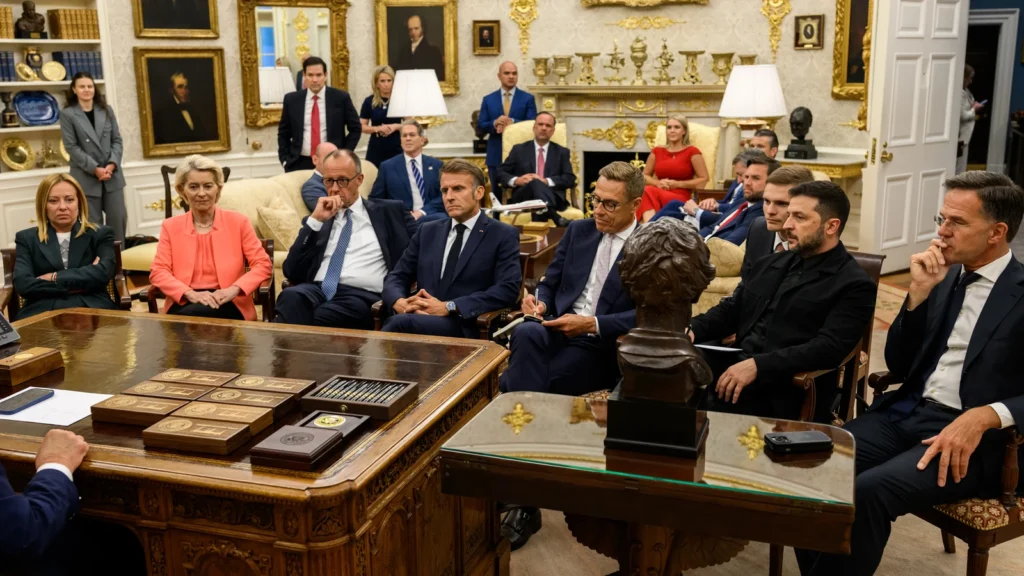
The recent Washington summit between President Zelensky and President Trump was a brutal dramatization of our growing irrelevance. The leading European figures, seated as subordinates on the other side of the Resolute Desk opposite the American president, symbolized the continent’s demotion. The image of Europe reduced to a mere extra, entering through the back door of the West Wing while others received honors, will be etched in the annals of history.
Europe is experiencing a systemic decline that encompasses all fronts: political, military, economic, industrial, technological, and demographic. It runs the very real risk of becoming an actor without weight or influence in the new world order. And it bears repeating: the decline of the American empire has been predicted so many times, often from Europe, and it is Europe that is rapidly heading toward irrelevance unless something is done urgently.