Chavismo has stopped being a Venezuelan political problem and has become a global security emergency. Chavismo is a successful criminal corporation that has taken an entire nation hostage. It is a terrorist narco-state that exports chaos, drugs, and misery
By Gustavo de Arístegui, as published in El Debate.
05 Dec. 2025 – 01:30
There are authoritarian regimes and then there is chavismo, which for twenty-six years has turned an immensely rich country into a laboratory of repression, organized crime, and institutional colonization. What began in 1999 as a populist experiment has, under Hugo Chávez Frías, Nicolás Maduro, and Cuban tutelage, transformed into a transnational criminal structure that combines the worst of Latin American Marxist-Leninist caudillismo with the most toxic elements of the Iran-Hezbollah axis and Colombian terrorist narco-guerrillas. Venezuela today is a lethal hybrid of dictatorship, drug cartel, and sanctuary for global terrorism.
The first front of the regime is internal repression. From its beginnings, chavismo turned justice into a weapon and the political police into an instrument of terror. Reports from the UN International Mission detail a systematic pattern of atrocities: extrajudicial executions – more than 6,800 just between 2018 and 2019 – torture with electric shocks and mechanical asphyxiation, and sexual violence used as a method of punishment.
After the massive electoral fraud of July 2024, the repressive machinery reached unprecedented levels, with thousands of arbitrary detentions, including the inhumane arrest of 220 children and teenagers.
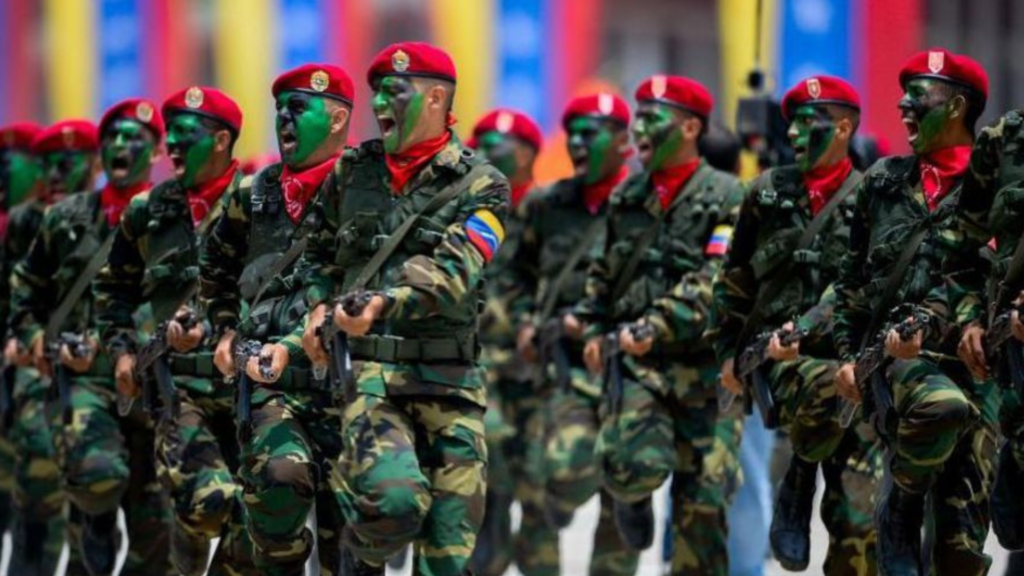
The brutal engines of repression – the Dgcim (military counterintelligence); special forces or FAES; and the Sebin (political police, the Venezuelan Stasi) – form a system designed to annihilate dissent through fear. Built on that repression was an epidemic of violence that made Venezuela the most insecure nation in the world, according to Gallup, with a homicide rate that in 2015 hit the ceiling of 90 per 100,000 inhabitants.
The human cost of this induced collapse is the largest exodus of the 21st century in the Western Hemisphere. According to UNHCR, 7.9 million Venezuelans have fled the country, a figure greater than the total population of many neighboring countries and comparable to the crises in Syria or Ukraine. They do not flee conventional warfare, but a country pillaged to the foundation.
The looting of national wealth defies imagination: in PDVSA, once a global energy pride, some $529 billion was diverted through corruption and exchange control schemes, while oil production collapsed to levels not seen in almost a century.
Faced with oil sector collapse, the regime turned to direct plunder of the land: the Orinoco Mining Arc. This territory of 111,000 square kilometers has become the most sinister face of contemporary chavismo. There, criminal syndicates and guerrillas, under the complicit watch of the Bolivarian National Armed Forces, impose a regime of modern slavery, human trafficking, and ecological devastation to extract “blood gold.”
But mining hides an even darker secret: the nuclear connection. Since 2008, and confirmed by Israel in June 2025, Venezuela has been supplying uranium to Iran. The circuit is perverse: extraction in Venezuelan mines, transport to the fake Cerro Azul cement plant, and final shipment to Tehran on PDVSA vessels.
This criminal ecosystem has allowed Venezuela to become the beachhead of jihadi terrorism in the Americas. Hezbollah’s presence is both operational and financial: active cells on Margarita Island, training centers, and a vast money-laundering network. The regime issues diplomatic passports to Iranian Intelligence and Revolutionary Guard agents, as well as to Hezbollah terrorists.
It uses the airline Conviasa to connect Caracas with Tehran and Damascus (which Venezuelans call “AirTerror”), integrating fully into the self-styled “axis of resistance” alongside Hamas, Hezbollah, the Houthis, and pro-Iranian terrorists in Iraq. Leaders of Hamas and Hezbollah are received with state honors at Miraflores Palace.
The symbiosis with organized crime completes the picture. For years FARC and ELN found in Venezuela their strategic rear. From that alliance was born the Cartel of the Suns, a drug trafficking organization embedded in the Venezuelan military high command that floods the United States and Europe with cocaine.
The confessions of Hugo “El Pollo” Carvajal in December 2025, in a letter to President Donald Trump, finally expose the cesspool: the former head of Intelligence confirms that Chávez created and armed criminal gangs, that Maduro exported them to destabilize the region, and that drug trafficking is state policy.
In this context, the rise of the Tren de Aragua is no accident. This mega-gang, born in the Tocorón prison, has mutated into a transnational threat operating from Chile to the United States, dedicated to contract killing, extortion, and human trafficking.
Its designation as a Foreign Terrorist Organization by the United States, like that of the Cartel of the Suns, is not rhetoric. They have become a grave hemispheric security threat that uses asymmetric violence and territorial control for criminal ends.
For all these reasons, the recent offensive by U.S. Southern Command against smugglers in the Caribbean cannot be judged through the lens of ordinary police incidents. The 22 attacks carried out since September 2025, with 83 killed, respond to a logic of legitimate defense against a narco-state that uses drugs as a mass chemical weapon against the U.S. population. The presence of the USS Gerald R. Ford carrier in the region underscores the gravity of the threat: this is not a fight against smugglers. It is a confrontation with a state terrorist structure.
Arguing in favor of these attacks and the terrorist designations is a matter of security and morality. First, because the Cartel of the Suns and the Tren de Aragua operate with total impunity inside Venezuela, protected by a state they have kidnapped. Second, because their links to Hezbollah and Iran’s nuclear program elevate the risk to a global level. And third, because cutting the flow of drugs and dirty money is the only way to weaken a regime that has shown itself immune to conventional diplomacy and timid sanctions.
Chavismo has ceased to be a Venezuelan political problem and become a global security urgency. Chavismo is a successful criminal corporation that has taken an entire nation hostage. It is a terrorist narco-state that exports chaos, drugs, and misery. Facing it with maximum force, treating its leaders as high-level targets of international organized crime, is the only path to stop the bleeding of a continent and restore freedom to a captive people.
Complacency and passivity in the face of those who have turned crime into their ideology and terror into their method of government are a particularly repugnant form of complicity.
Gustavo de Arístegui San Román is a diplomat and was Spain’s ambassador to India.