
By Gustavo de Arístegui, as published by La Razón, 8 February, 2026
The Asian country is not just electing a Parliament: it is deciding what kind of power it wants to be in an increasingly dangerous world, and its consolidation as a liberal democracy.
I’m writing these lines in one of the basements of the buildings in Japan’s Wall Street, the Marunouchi district. Here, young executives crowd into the restaurants, bars, and cafes of this veritable underground city where you can find everything. There’s not a spare inch in any establishment, offering Japanese cuisine in its myriad variations, as well as Spanish, Italian, and French dishes, all within the bars. The hustle and bustle, the conversations, and the laughter are like anywhere else on the planet, but certainly more restrained, polite, discreet, and civil. Street safety is almost absolute. Civility and respect prevail, even when queuing to cross the street. A renewed optimism is palpable; money is flowing, and tourists are flocking to shops in a country where, with a weak yen, the currency is no longer prohibitively expensive. In this atmosphere, the election campaign is barely noticeable, except in Los Barrios or the smaller towns where posters are displayed in designated, numbered locations. Vans with loudspeakers are few and far between, and always operate at a civilized volume. This great country, with its serious problems, deep demographic crisis and galloping public and private debt, is
a vigorous democracy and a country that works and respects and believes in its institutions.
Japan is not just electing a parliament : it is deciding what kind of power it wants to be in an increasingly dangerous world. In the snap elections on February 8, all signs point to a landslide victory for Sanae Takaichi’s Liberal Democratic Party (LDP) and its reformist partner, Nippon Ishin no Kai. But the key is not the arithmetic result, but what it signifies: the consolidation of Japan as a great liberal and representative democracy, firm in matters of security and defense, proud of its values, and prepared to assume its strategic responsibility in the Indo-Pacific and in the turbulent world of the 21st century.
For decades, political Japan has been synonymous with prudence, calculated ambiguity, and constitutional pacifism. Today, faced with Chinese expansionism and increasingly serious nuclear threats from North Korea, the country is entering a different phase : confronting the challenges, not hiding from them.
A system designed for stability, in an increasingly unstable environment
Takaichi decided to dissolve the House of Representatives early just a few months after coming to power, forcing
elections in the midst of geopolitical realignment and in a delicate internal context : a slow but real exit from deflation, moderate inflation, but not so much in food, which has taken its toll on the pockets of the middle classes, and a very serious demographic implosion.
The Japanese electoral system—289 single-member districts and 176 proportional representation seats—favors large blocs and penalizes fragmentation. If the polls are correct, Takaichi’s LDP could increase its representation from fewer than 200 seats to close to or exceeding 250 (an absolute majority is 233), and the coalition with Ishin would approach a two-thirds majority in the House of Representatives. This would mean the ability to set the legislative agenda without depending on other parties, and even to pursue constitutional reforms if a majority can be secured in the House of Representatives. In a country where institutional inertia has been the norm, this room for maneuver is unprecedented.
Facing this right-wing national-reformist bloc, the new centrist alliance, which brings together the former Constitutional Democratic Party (a fusion of liberals and social democrats—oil and water) and Kōmeitō (centrists who were former coalition partners of the LDP), is trying to present itself as a moderate alternative and proclaims itself “social-liberal.” The opposition coalition’s message is failing to resonate with an electorate that, after decades of stunted growth, is demanding three very specific things: security, both internal and external; a recovery of purchasing power; and strong, charismatic leadership.
The “Thatcher of Asia”: a national-popular conservatism, neither disruptive nor populist
Sanae Takaichi has achieved something few would have imagined a few years ago: transforming the LDP, that behemoth of clientelism, factions, and fratricidal internal power struggles, into the vehicle for a coherent, center-right, national-popular project. She does so with a distinctly Japanese blend of continuity and rupture. On the one hand, she maintains classic LDP elements: a strong state, close ties with large corporations, sensitivity towards rural areas, and defense of the middle class. On the other, she introduces a new language of discipline, effort, merit, national pride, and firmness in the face of external threats.
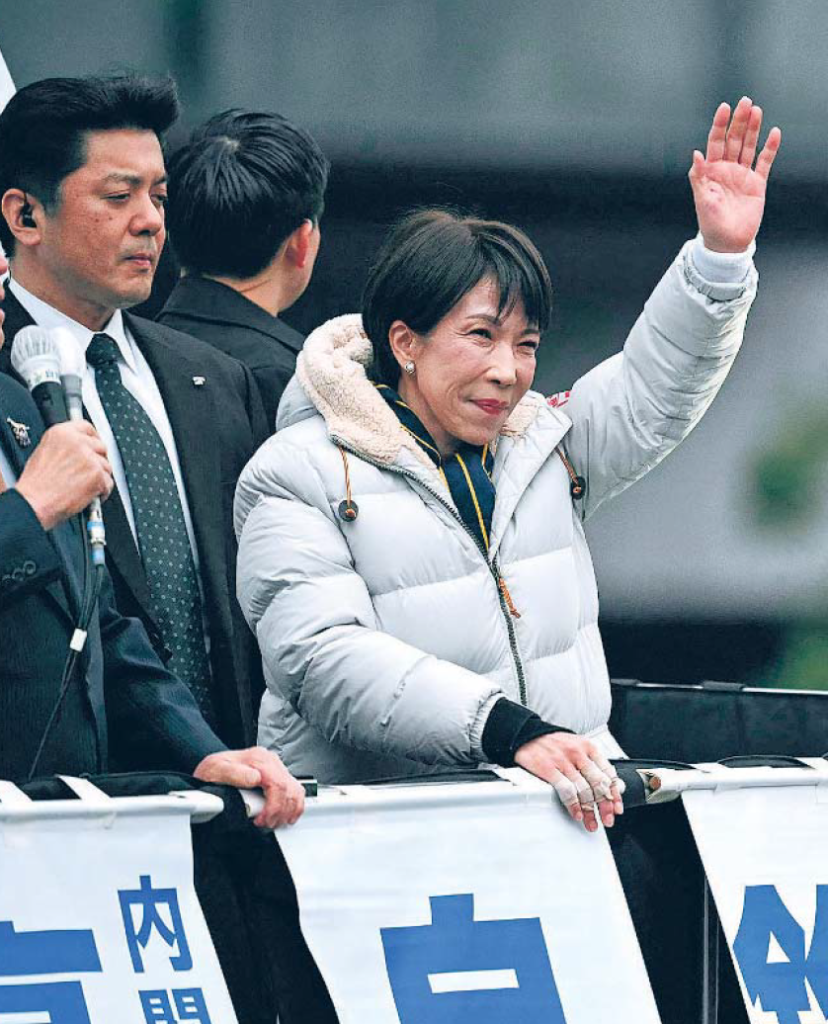
Takaichi’s project rests on three pillars: first, her enormous popularity, even among younger voters ; her rallies draw massive crowds, a rare occurrence in this country. Her style and hairstyle are widely imitated, and cookies bearing her likeness and that of Margaret Thatcher, to whom she is invariably compared, are sold. Second, her excellent reputation as a tireless worker in a country that revers effort, rigor, and seriousness. Third, her bold and conservative political project, which promotes fiscal responsibility, reducing Japan’s immense debt, and a strong and assertive foreign policy toward China and other revisionist actors, while also being mistakenly aligned with the most advanced democracies and maintaining a sincere friendship with political leaders like Donald Trump and Giorgia Meloni. It is neither the suicidal fiscal populism of certain European left-wing movements nor the economic isolationism of some populist right-wing movements; it is a cold, technocratic, and patriotic national developmentalism.
Ishin, the reformist partner, completes the picture from the modernizing right: administrative reform, medium-term fiscal discipline, a reduction in the size of a bloated bureaucracy , and centralism in the face of local power struggles. It is an uncomfortable alliance for the old guard of the LDP, but very attractive to urban middle-class voters (the biggest victims of years of stagflation) tired of paralysis and wanting reforms without risky ventures. Takaichi’s commitment to a “high-pressure” economy is much more than “Abenomics 2.0” (fiscal responsibility). Takaishinomics is based on sustained growth, since without decent and rising wages, as well as a minimum of confidence in the future, Japan will not be able to finance its defense, maintain its welfare state, or correct its demographic implosion. That is why he proposes a “high-pressure” economy: keeping demand above its equilibrium level to encourage companies to invest, raise wages, and improve productivity.
This translates into several lines of action:
– Temporary subsidies for gasoline, electricity and gas to protect families while the recovery takes hold.
– Re-allocating the budget towards investment in innovation, digitalization, a realistic green economy, critical infrastructure and defense.
– Explicit coordination with the Bank of Japan to ensure that monetary policy supports and does not hinder fiscal stimulus as long as inflation remains at tolerable levels.
Security and defense: Japan takes the real world seriously
It is in the realm of security that these elections take on a significance that transcends Asia. In a context of global geopolitical volatility, Japan is finally abandoning the comfort zone of constitutional pacifism . And it is doing so with a clarity that many European capitals would envy.
Takaichi proposes increasing defense spending to 2% of GDP (currently at 1.4%), strengthening counterattack capabilities, investing in cyber defense and cutting-edge technology, and assuming greater responsibility within the alliance with the United States. This is not a bellicose shift, but a belated adjustment to a reality that has changed radically since the drafting of the postwar Constitution. An advanced democracy surrounded by revisionist powers cannot continue acting as if it were an Asian Switzerland; either it equips itself with a credible deterrent capability, or it will remain at the mercy of decisions made in Beijing, Pyongyang, or Moscow.
A political realignment with global effects
If Takaichi’s LDP and its allies in Ishin achieve the reinforced majority predicted by the polls, Japan will have completed a profound political realignment . The center of gravity will clearly shift toward a reformist, national-popular right wing deeply rooted in the expanded Atlantic axis.
– A strong and proactive Japan is a first-rate partner in the Indo-Pacific against Chinese expansionism and the Moscow-Beijing-Pyongyang axis.
– In a context of doubts about the long-term US commitment, Tokyo can become a pillar of stability and a bridge between the West and democratic Asia.
– The Japanese example demonstrates that it is possible to build a center-right agenda that combines a firm defense of the liberal order, strategic realism, and economic policy sensitive to the middle classes, without falling into either protectionist populism or irresponsible anti-economic populism.
Why these elections should matter in Madrid, Paris and Brussels
Japanese elections don’t usually make headlines in the European media. They’re seen as a distant, technical matter, “by the Japanese for the Japanese.” This is a grave mistake. What happens in Japan today will influence the balance of power in the Indo-Pacific , the deterrent capacity against China, the architecture of sanctions against Russia, and the room for maneuver of democracies vis-à-vis authoritarian regimes.
A Japan governed by a leader who understands, as Thatcher did, that defense, the economy, and values are all part of the same equation , is a valuable ally for those of us who believe in representative liberal democracy, the social market economy, and the need for a foreign policy based on principles, not mere gestures. It is also an uncomfortable mirror for a Europe that talks a lot about “strategic autonomy” but invests little in defense, is divided over Russia, and maintains an ambiguity with China that borders on recklessness.
Japan has decided it doesn’t want to be an object of history, nor a passive subject; it wants to be the protagonist of its geostrategic destiny, and the key lies in Takaishi’s victory today. If confirmed, we will see how this great nation positions itself as one of the essential pillars of a new front of strong democracies against the authoritarian wave. Europe should take note: in the world to come, one either stands with those who take the defense of freedom seriously, or one ends up living under the rules of those who crush it. Japan seems to have clearly chosen the former path. Now it is up to the West to rise to the occasion.