By Gustavo de Arístegui, as published by La Razón, January 25, 2026.
The Republican’s second term demonstrates that the West must choose between regaining its “hard power” or accepting irrelevance in a multipolar world.
A year has passed since Donald J. Trump entered his second term , and the international stage resembles a landscape in the aftermath of a hurricane that shows no signs of abating. To understand this phenomenon, it’s worth enshrining in stone the words of former Republican congressman, Colonel, and B-2 bomber pilot Chris Stewart: “Trump should be taken seriously, but not at face value .” However, after twelve months characterized by a strategy of outbursts and a negotiation tactic based on shock tactics, the world—and especially Europe—has discovered that the problem isn’t just the literal interpretation of his words, but the systematic erosion his methods inflict on an already weakened transatlantic relationship.
The deterioration of the Western order is not solely the responsibility of Trump’s verbal excesses or his unpredictable policy shifts. It is, to a large extent, the consequence of a loss of prestige and credibility among Western political classes in general, and the European class in particular. We are facing a profound crisis of the democratic system, exacerbated in the European Union by a bloated and inefficient bureaucratic structure that seems incapable of responding to an interlocutor who only respects strength and despises weakness.
The Trump Method: The Shock Strategy and Outbursts in Foreign Policy
The Trump of 2025 is a political animal who has learned to master the levers of federal power. Unlike his first term, where internal chaos and constant resignations were the norm, today he has a cohesive team: Susie Wiles behind the scenes, Marco Rubio in diplomacy, and Scott Bessent at the Treasury. But this greater administrative efficiency hasn’t softened his style; it has given him the freedom to focus on the international stage rather than putting out domestic fires.
Trump practices what we might call “high-impact transactional diplomacy .” He uses deliberate outbursts to unsettle his counterparts, overwhelm them with impossible demands, and ultimately extract concessions that would take decades to materialize in a normal diplomatic environment. However, this method comes at a very high cost: the destruction of trust among allies. As Henry Kissinger warned, an international order based solely on transaction and not on shared principles is inherently unstable. The abrupt shifts in policy—one day threatening allies with tariffs, the next proclaiming reconciliation—have turned American foreign policy into a perpetual box of surprises.
The Vulnerable Flank: The Decline of European Elites
This is where the analysis of Andrew Bustamante, a former CIA agent before the European Parliament, takes on prophetic relevance. According to Bustamante, the erosion of democratic trust in Europe is not an accident , but a critical vulnerability that powers like China, Russia, and even this new, unpredictable United States are exploiting. The diagnosis is devastating: Europe continues to operate as a “permissive” environment for foreign intelligence and geopolitical pressure because its leaders have neglected hard power.
The European political class has lived under the illusion that soft power (diplomacy, values, and culture) was sufficient to guarantee security. Bustamante argues that Europe has a poor track record of strategic leadership since 1945 , merely following a United States that is now entering its own phase of internal decline. All of this is compounded by a slow European bureaucracy, obsessed with institutional multitasking and endless processes, while the real world demands speed and decisiveness. This bureaucratic inefficiency is the perfect breeding ground for figures like Trump to treat the EU not as a partner, but as an obstacle or, at best, a client.
The Davos Mirage: Merz, Macron and Carney facing the Storm
At the recent World Economic Forum in Davos, European leaders attempted to project an image of unity and resilience that, in the eyes of many analysts, lacks the necessary material foundation. German Chancellor Friedrich Merz tried to rouse the “European locomotive” with a discourse of economic realism, admitting that Germany and the EU must take responsibility for their own defense if they want to be taken seriously in Washington. However, his rhetoric clashes with an industrial reality weakened by energy costs and technological dependence.
Emmanuel Macron, for his part, insisted on his now-classic “strategic autonomy.” Macron sees the transatlantic crisis as the ultimate opportunity for the EU to become a third global power. But his pronouncements ring hollow when the Union’s structure remains the aforementioned “bureaucratic behemoth.” Technological and defense sovereignty is not built with rhetoric, but with massive investment and a streamlining of the regulations that are stifling European growth.
Finally, Mark Carney, from his financial perspective, warned of the end of the “Washington Consensus” and the fragmentation of the global economy. Carney pointed out that the credibility of Western institutions is at historic lows because they have failed to manage the transitions (climate, technological, migration) in a way that makes citizens feel protected. The crisis of democracy is, in essence, a crisis of competence: citizens no longer believe that their politicians can solve their problems.
The Greenland Case: Where Outburst Meets 21st Century Geopolitics
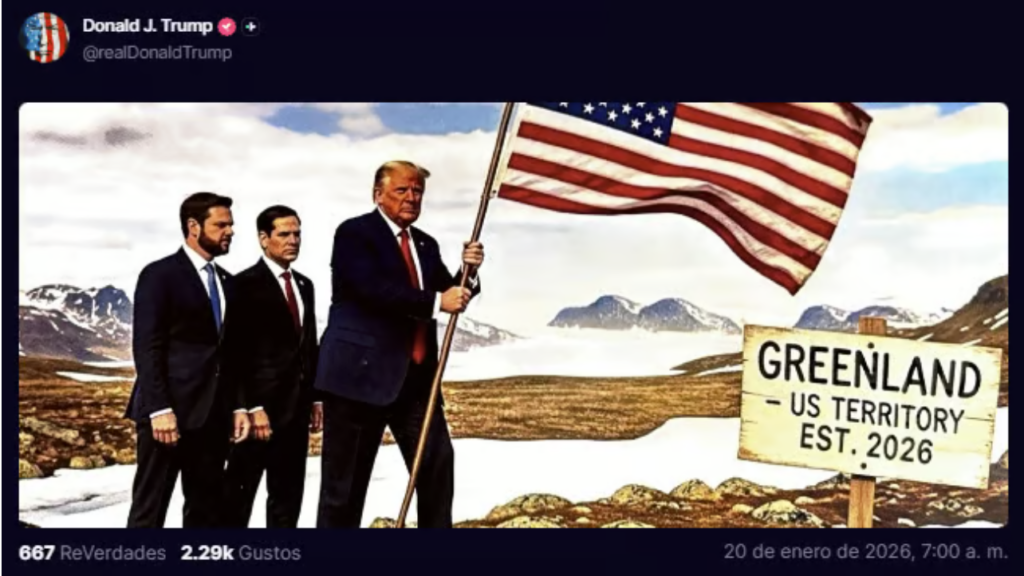
One of the clearest examples of all this is the clash between Trump’s style and the real strategic importance of Greenland . What was met with derision and disdain during his first term—the idea of buying the island from Denmark—must be analyzed today with an unbiased perspective.
No one with any understanding of geopolitics can deny that
Greenland is the Arctic’s “unsinkable aircraft carrier .” Allowing this territory to fall under Russian or Chinese influence would be a strategic disaster for Western peace and stability. Early warning and defense against ballistic missile attacks, control of northern shipping lanes, and access to the island’s vast mineral resources are 21st-century security priorities.
The hostility toward Danish and European allies, including threats of tariffs, is a diplomatic and geopolitical blunder. Nevertheless, Greenland’s geostrategic importance is undeniable, but President Trump’s attitude jeopardizes the very essence of NATO. The Arctic cannot be protected by destroying the alliance that is meant to defend it. This outburst has gone beyond the bounds of strategy and entered the realm of diplomatic arson. A reasonable solution must be found that guarantees Western security without humiliating or alienating European partners.
The Credibility Crisis and the Rise of Distrust
The underlying problem is that Trump is not the cause, but rather a symptom of a deeper malaise. The loss of prestige of traditional political classes has left a void that transactional populism easily fills . Andrew Bustamante is right to point out that effective leadership rests on competence (delivering on promises) and genuine connection with the people. In Europe, the perception is the opposite: an elite disconnected from reality, sheltered in regulations and rules that seem designed for a world that no longer exists.
The EU faces multiple risks: its security and stability; but above all, the very essence of our systems of freedoms and democracies is at risk. If Western institutions cannot demonstrate that they are more effective than authoritarianism, the democratic system will reach the point of no return, and authoritarian regimes and populism will advance unchecked.
Towards a responsible and proactive Pragmatism
Europe, and countries like Spain in particular, must learn a vital and urgent lesson: in the face of this new world order, neither the enlightened condescension of the Davos elites nor the perpetual moral outrage of Europeans will suffice. What is needed is intelligent pragmatism.
This involves three immediate actions:
- Reclaiming Hard Power: Following Bustamante’s advice, Europe must build genuine technological and defense sovereignty, assuming the political and budgetary costs this entails. Peace is not begged from Washington; it is deterred from Brussels, Berlin, Paris, and Madrid.
- Radical Bureaucratic Reform: The EU must reform its bloated structure. In a world of “shock strategies,” administrative slowness is a geopolitical death sentence.
- Servant Leadership: Political elites must regain credibility through competence. Prestige is earned by solving problems and exercising effective leadership.
The transatlantic paradox— maintaining a transatlantic alliance while fundamentally dependent on the US—is unsustainable today . Washington demands strategic autonomy from Europe while simultaneously attempting to keep it subordinate to its military-industrial complex. Europe must choose: either it becomes a power in its own right in a multipolar world, or it accepts being a theme park of 20th-century democracy, managed by an inefficient and opaque European bureaucracy that cannot remain under the volatile and unpredictable protection of the current US president.
In the end, as Burke warned, “A state without the means to change lacks the means to preserve itself.” The West must change its understanding of geopolitics and power if it wants to preserve freedom. Trump has held a mirror up to us; what we see in him is not only his defiant face, but also our own weakness and indecisiveness. It is time to start taking the survival of our own democratic system and freedoms seriously.